Intermediate📖 15 min read🏷 Time & Sessions
KILLZONES & MACRO TIMES
SHARE FREE:
Time Is Your Edge — Studying Institutional Trading Windows
ICT Flow EditorialIndependent educational resource
This lesson explains concepts commonly taught in ICT/SMC trading education and presents them as frameworks to study and test. Chart patterns cannot independently prove institutional intent, future price delivery, or profitability. Examples and rules are educational, not trading advice.
Read our editorial standards →Session timing can matter alongside setup selection, but neither timing nor setup type should be assumed to dominate across all markets. A setup's behavior can differ across session times; performance should be measured for the specific market and rules rather than assumed to succeed or fail at a particular time. ICT's Killzone framework provides defined time windows for studying session behavior; it does not establish that an algorithm delivers price on a fixed schedule. Killzones are an ICT time-window framework. Trading outside them is not inherently gambling, and trading inside them does not guarantee a valid setup.
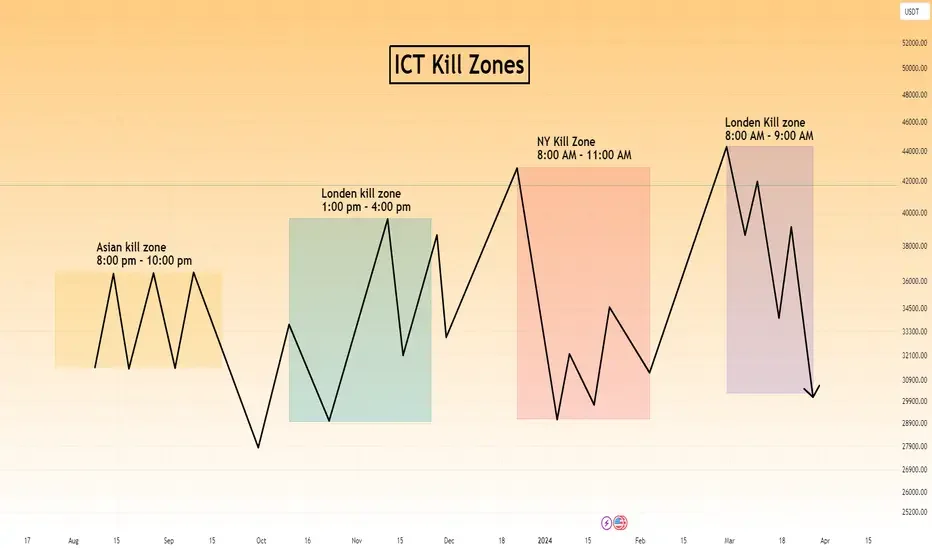
The four ICT Killzones — Asian, London, New York AM, and London Close
// Lesson Content
Killzones are specific time windows during the trading day when some traders study these windows for changes in activity and liquidity; claims about IPDA activity cannot be directly verified from a chart. Some traders study these windows because of observed session behavior and liquidity patterns; reliability and reversal frequency should be evaluated with data for the instrument and rules used.
Outside of Killzones, market behavior can vary in liquidity and activity. Some ICT traders restrict entries to these windows, while others use them as one contextual filter; the choice should be evaluated against a defined trading plan.
ICT teaching commonly divides the day into four named Killzones and assigns possible roles within a daily narrative. These labels organize one interpretive framework; they do not show that each session has a fixed purpose or that a daily AMD sequence will occur.
📌 Some traders use Killzones as an execution filter; whether to restrict entries to those windows depends on the tested trading plan. Outside those windows, market behavior can still occur; whether a session window improves a setup should be tested in the trader's own plan.
Asian Killzone (8:00 PM – 12:00 AM EST):
ICT label sometimes used: accumulation. The range may be a useful reference, but it does not confirm participant positioning. ICT teaching sometimes frames this session as accumulation, but actual participant positioning cannot be confirmed from the chart alone. The high and low of the Asian session = critical levels. Price may revisit or sweep one of these levels during London or New York. Mark them every single day.
London Killzone (2:00 AM – 5:00 AM EST):
ICT label sometimes used: possible manipulation/Judas Swing; it is a hypothesis, and outcomes vary by market and day. Price may sweep one side of the Asian range before reversing, but the move, participant intent, and direction can vary by market and day. Some ICT traders avoid opening minutes or watch for a move beyond the Asian range. This is a model-specific filter, not a universal rule; define the time and sweep conditions and test the results.
New York AM Killzone (7:00 AM – 10:00 AM EST) — or 8:30-11:00 AM:
ICT label sometimes used: distribution. Directional expansion can occur, but the session's role is not fixed. Volatility and directional behavior can vary by market and day, and institutional positioning cannot be confirmed from the chart alone. The Silver Bullet trade runs entirely within this window (specifically 10:00-11:00 AM EST for the NY AM Silver Bullet).
London Close Killzone (10:00 AM – 12:00 PM EST):
Possible interpretation: reversal or profit-taking. The behavior varies by session and market; this is not a fixed role. The behavior varies by session and market, and specific bank positioning cannot be confirmed from a chart. ICT traders either close positions here or look for a fade trade.
📌 London = fake out (Judas). NY AM = real move. This two-step pattern is commonly taught within the AMD framework; its occurrence and usefulness should be evaluated across the market and session being studied.
Beyond Killzones, ICT introduced "Macro Times" — 20-minute windows within sessions that some ICT teachings use as additional timing references; traders can test whether they add useful context.
The key Macro Times (all EST):
• London Macro 1: 2:33 AM – 3:00 AM
• London Macro 2: 4:03 AM – 4:30 AM
• New York AM Macro 1: 8:50 AM – 9:10 AM
• New York AM Macro 2: 9:50 AM – 10:10 AM
• New York AM Macro 3: 10:50 AM – 11:10 AM
• Lunch Macro: 11:50 AM – 12:10 PM
• PM Session Macro: 1:10 PM – 1:40 PM
• Last Hour Macro: 3:15 PM – 3:45 PM
Some ICT teachings describe these windows as periods when price may move toward a liquidity reference. The chart does not establish that a specific algorithm causes the move or that a target will be reached. The Silver Bullet is commonly studied during selected windows, but its effectiveness should be tested against clearly defined rules.
📌 Macro Times are ICT time-window concepts that some traders study for session behavior. Their precision and usefulness should be evaluated for the market and strategy being tested.
One of the most practical applications of the session framework is marking the Asian Range every single day. Here's why it matters:
The Asian session commonly forms a definable high-low range. ICT traders may interpret this range as an accumulation reference, but institutional positioning cannot be confirmed from the range alone.
London and New York sessions can interact with the Asian range. A sweep of one or both sides is not required, and target reliability varies by market and conditions.
Daily routine:
1. At midnight EST, mark the Asian Range High and Low
2. During London open (2-5 AM), watch which side gets swept first
3. Record whether a sweep occurred; do not label it a Judas Swing without defined criteria.
4. Track whether price reversed, continued or remained in a range.
5. Use the result as one observation, not a standalone NY AM directional bias.
The Asian-range sweep-and-reversal setup is an example traders may study; reported profitability depends on the trader, market, execution, costs, and rules used. The initial sweep does not prove the next move will go in the opposite direction or establish a New York bias.
📌 Marking the Asian Range can provide session context. London may sweep one side, both sides, or neither; use the result as one input rather than a guaranteed NY bias.
// Test Your Understanding
// KNOWLEDGE CHECK
1. The London Killzone is primarily known for...
2. The New York AM Killzone serves the role of...
3. Macro Times are approximately...
// What to study next
Continue your ICT journey