Intermediate📖 22 min read🏷 PD Arrays
ORDER BLOCKS
SHARE FREE:
An ICT Framework for Studying Potential Institutional Price Zones
ICT Flow EditorialIndependent educational resource
This lesson explains concepts commonly taught in ICT/SMC trading education and presents them as frameworks to study and test. Chart patterns cannot independently prove institutional intent, future price delivery, or profitability. Examples and rules are educational, not trading advice.
Read our editorial standards →Order Blocks (OBs) are a major price-delivery concept in the ICT methodology. While an FVG is used to describe a price imbalance, an Order Block is a chart zone that ICT traders study as a potential area of prior buying or selling. The underlying participant orders and intent cannot be confirmed from the chart alone, so traders should define and test the conditions they use to mark an OB.
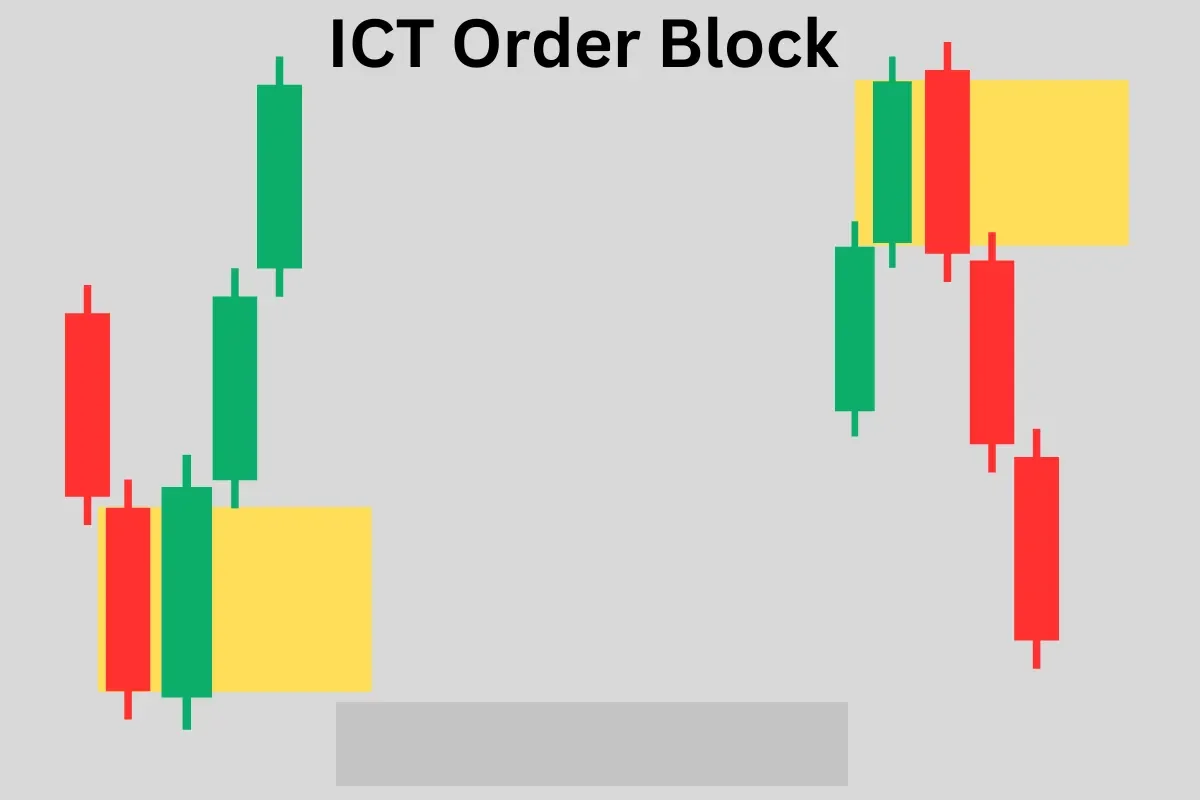
Bullish OB: last bearish candle before a strong bullish move — an ICT zone studied as a potential reaction area
// Lesson Content
An Order Block is the last opposing candle before a strong impulse move. It represents the candle where an institution was absorbing all retail orders — quietly filling their position against the crowd — before launching price in their intended direction.
Bullish Order Block:
• The last BEARISH (red) candle before a significant bullish move
• ICT interpretations may describe this candle as an area of institutional buying; actual participant positioning cannot be confirmed from the candle alone.
• The OB zone = the body of that last bearish candle (open to close)
• Price may revisit this zone and react, but the response should be treated as a testable outcome rather than an expectation
Bearish Order Block:
• The last BULLISH (green) candle before a significant bearish move
• ICT interpretations may describe this candle as an area of institutional selling; actual participant positioning cannot be confirmed from the candle alone.
• The OB zone = the body of that last bullish candle
• Price returns here as resistance
In this ICT-style framework, traders may define an OB confirmation using a BOS/ChoCH, an FVG, and displacement; these are model criteria to test rather than universal validation rules.
📌 In ICT terminology, an Order Block is studied as a candle/zone associated with a subsequent displacement move. Claims about unfilled institutional orders should be treated as a theoretical interpretation.
Not every candle before a move is a valid Order Block. ICT gives specific criteria for validity:
1. Some ICT traders look for displacement after an OB, often accompanied by large directional candles and FVGs. A slower move may be treated differently depending on the model; test the rule rather than assume it is universally valid.
2. The move must include a BOS or ChoCH — confirming that structure shifted after the OB candle. This is interpreted within the ICT model as evidence of a potential structural shift; institutional intent cannot be confirmed from chart structure alone.
3. Mitigation threshold — once price returns to the OB, it should react within the body of the OB candle. Specifically, ICT says a bullish OB is valid if price holds above the 50% level of the OB candle (the midpoint between open and close).
4. Volume context — higher volume on the OB candle and the displacement move adds validity.
5. Higher-timeframe alignment — some traders use a Daily OB as context for a 5-minute OB. Whether this adds value depends on the model and should be tested. Always record the timeframe of the OB.
📌 OB validity checklist: (1) displacement after it ✓ (2) BOS or ChoCH after it ✓ (3) FVG in the displacement ✓ (4) HTF alignment ✓
ICT has developed several OB variations over the years:
Breaker Block: An Order Block that FAILED. When price returns to an OB and instead of reversing, it blasts through — that OB is now a Breaker Block. In a bullish scenario: a bearish OB that gets violated to the upside becomes a support zone (breaker). Within the ICT interpretation, a breaker may be discussed as a former OB that changes role after being violated; the chart alone cannot confirm that institutions defended or added to a position.
Mitigation Block: When an OB is partially filled — price enters the OB but not fully. ICT considers partially mitigated OBs as still valid for future tests.
Rejection Block: The WICK of a candle before a strong move, rather than the body. When price creates a long wick before launching, that wick zone is a rejection block — slightly different from a standard OB.
Hidden OB: An OB that exists on a higher timeframe but is not visible when looking at a lower timeframe alone. Requires multi-timeframe analysis to identify.
Reclaimed OB (2024): If an OB gets swept through but price quickly returns inside it — the OB is "reclaimed" and is still valid for trading.
📌 Breaker Block is the OB that failed. When an OB gets broken through, it inverts polarity and becomes support (if bullish) or resistance (if bearish).
Both can be studied as potential entry zones within the framework, but they are fundamentally different:
Order Block = WHERE institutions entered (the candle they used to build their position). It's about position accumulation.
Fair Value Gap = WHERE price moved too fast and left an imbalance. It's about price inefficiency.
An OB that overlaps an FVG is one commonly studied ICT confluence pattern; whether it improves outcomes should be tested. ICT calls this a "confluence" zone. When an Order Block and FVG overlap, traders may treat the combination as additional confluence; its effectiveness should be tested rather than assumed.
How to determine which to use:
• OBs are better for swing trades and higher timeframe setups
• FVGs are better for intraday precision entries on 5m/15m
• When they overlap, some traders treat the area as additional confluence; confidence and performance should be evaluated rather than assumed.
• Consider both as part of the checklist if your tested strategy uses them.
📌 OB + FVG overlap can provide additional confluence in an ICT-style setup; it does not guarantee a better outcome.
// Test Your Understanding
// KNOWLEDGE CHECK
1. A Bullish Order Block is identified as...
2. A Breaker Block forms when...
3. Which combination is commonly studied as a confluence example in ICT-style entries?
// What to study next
Continue your ICT journey