Intermediate📖 25 min read🏷 Execution
ICT ENTRY MODELS
SHARE FREE:
Common ICT Entry Models: Rules to Define and Test
ICT Flow EditorialIndependent educational resource
This lesson explains concepts commonly taught in ICT/SMC trading education and presents them as frameworks to study and test. Chart patterns cannot independently prove institutional intent, future price delivery, or profitability. Examples and rules are educational, not trading advice.
Read our editorial standards →Having all the concepts in your head means nothing if you don't know HOW to combine them into a concrete trade entry. ICT entry models are structured, repeatable frameworks for defining potential entries. Their rules can be precise, but meeting the conditions does not guarantee a high-probability or profitable outcome.
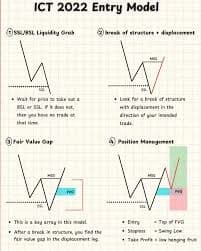
Examples of ICT entry rules that traders can define, test and adapt
// Lesson Content
One commonly taught ICT entry checklist includes the following candidate conditions; no single list is a universal requirement for every strategy:
1. CONTEXT — Define higher-timeframe conditions if the model uses them; specify how neutral or conflicting context affects a trade.
2. REFERENCE LEVEL/TRIGGER — If the model requires a sweep, define the level and what counts as a break; a sweep alone does not prove a reversal.
3. CONFIRMATION — Define displacement or structure conditions when the model requires them; do not assume every reversal must be impulsive.
4. ENTRY — Specify whether and how FVG, OB or OTE references matter to this model, and state the exact entry trigger.
5. INVALIDATION — Set the stop from a written invalidation rule; a beyond-sweep stop is one option when the model calls for it.
6. EXIT — Define target selection in advance; a liquidity level is one possible target, not a required destination.
When these six elements are present, the example matches this lesson's checklist. Traders can define their own minimum requirements and test whether each element adds value.
📌 One example ICT checklist is HTF bias + liquidity sweep + displacement + entry array + clear target. Treat these as testable criteria rather than universal requirements.
This is one illustrative ICT-style entry model; its rules and results should be tested rather than treated as universally fundamental.
EXAMPLE SEQUENCE:
1. Define a prior low or equal-low reference using a consistent swing rule.
2. Record whether price moves below the reference during the selected window.
3. If the model requires reversal confirmation, define an observable trigger such as a structure shift.
4. Define an entry condition rather than assuming every return to an FVG is tradable.
5. Set the stop from the model's invalidation rule and specify a target before entry.
The sequence can fail or never trigger. Candle counts, entry location and target behavior vary, so define the rules in advance and measure them across all qualifying examples.
📌 A liquidity-sweep reversal is one model to define and test. Specify the reference level, trigger, entry, stop, target and invalidation; it is not universally required or superior.
ILLUSTRATIVE ORDER-BLOCK MODEL:
Some ICT traders label the last opposing candle before a strong directional move as an Order Block. To test an OB entry, define which candle qualifies, whether the reference is the candle body or full range, the entry trigger, stop/invalidation and target.
Some models study the first return to a marked OB or use a retracement such as its midpoint. Neither a touch nor a trade through the zone has a universal meaning; write down exactly what constitutes entry, mitigation and invalidation for the strategy being tested.
📌 📌 Some ICT traders prioritize the first return to an OB. Define the entry, invalidation and management rules in advance and validate them with historical data.
One commonly taught Silver Bullet version is associated with named 60-minute New York or London windows. Document the timezone and daylight-saving convention used by your source, since clock labels can differ.
EXAMPLE CONDITIONS TO DEFINE:
1. Specify the selected time window.
2. Define higher-timeframe context if required by the model.
3. State exactly what counts as a liquidity interaction or sweep.
4. Define the structure/FVG condition and entry price.
5. Set invalidation and exit rules, including any risk-to-reward filter.
The setup does not have to appear every day, and neither a window nor a named pattern guarantees a valid or profitable trade. A 2:1 target is one possible strategy rule, not a universal requirement for the Silver Bullet label.
📌 Silver Bullet is an ICT-labelled time-window model. Define the timezone and conditions, then test whether the window adds value; the label itself is not an edge.
Some ICT models label an Order Block that price trades through as a potential Breaker candidate; the label does not prove liquidity was consumed. Within this ICT interpretation, a former OB may be marked as a potential role-reversal zone; it does not necessarily become support or resistance after a break.
HOW A BREAKER FORMS:
• A Bullish OB exists
• Price sweeps THROUGH the OB (structure breaks)
• Within the ICT model, the former OB may be marked as a Bearish Breaker candidate
• Price pulls back to this zone — it now acts as resistance
THE SEQUENCE (Bearish Breaker):
Step 1 — Former Bullish OB swept through
Step 2 — HTF must be bearish
Step 3 — Price pulls back UP to the Breaker
Step 4 — Look for rejection (bearish FVG or LTF ChoCH)
Step 5 — Enter short at the Breaker
Step 6 — Stop: above the Breaker zone
Step 7 — Target: next SSL below
Within ICT terminology, Breakers are studied as failed Order Blocks that may change role; claims about “exhausted liquidity” are an interpretation and should be tested.
📌 In ICT terminology a Breaker is a failed-OB reference some traders interpret as a possible role reversal; define confirmation and invalidation rather than assuming a flip.
// Test Your Understanding
// KNOWLEDGE CHECK
1. Which list matches the example checklist in this lesson?
2. The Silver Bullet 10:00 AM window closes at?
3. What happens when an Order Block is swept through?
// What to study next
Continue your ICT journey