Intermediate📖 45 min🏷 ICT & SMC
TOP-DOWN ANALYSIS
SHARE FREE:
From Monthly context to 1-minute execution
ICT Flow EditorialIndependent educational resource
This lesson explains concepts commonly taught in ICT/SMC trading education and presents them as frameworks to study and test. Chart patterns cannot independently prove institutional intent, future price delivery, or profitability. Examples and rules are educational, not trading advice.
Read our editorial standards →Top-down analysis is a multi-timeframe process: start with broad context, identify meaningful levels and liquidity, then move down toward the timeframe where the actual entry is defined. The purpose is not to make the lower timeframe obey the higher timeframe; it is to make the relationship between context and execution explicit.
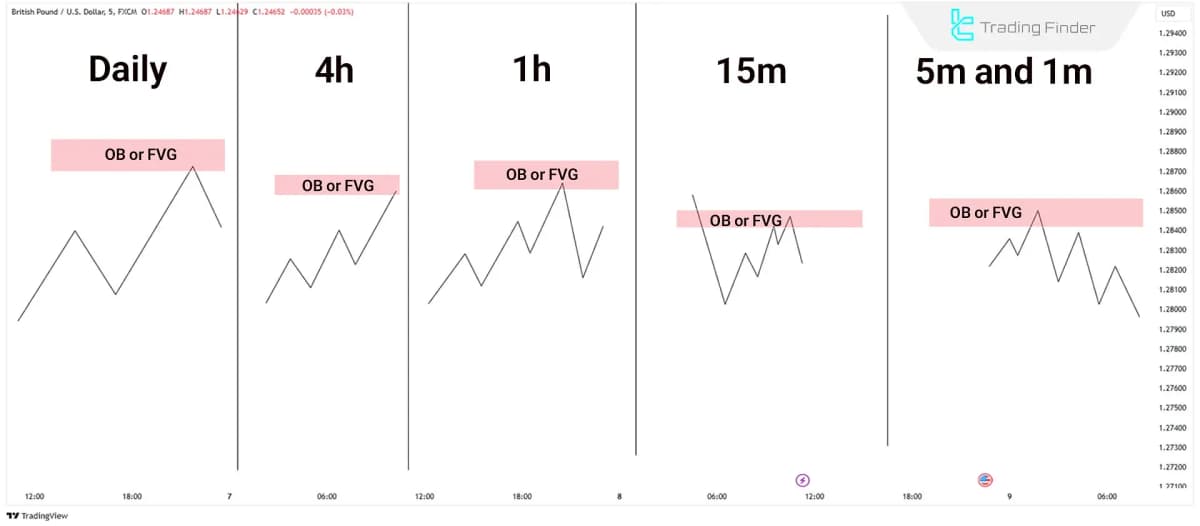
Top-down analysis moves from higher-timeframe context toward lower-timeframe execution while keeping the definitions and invalidation rules consistent.
// Lesson Content
Begin with the largest relevant structure. Mark major swing highs and lows, important gaps or arrays, and the current dealing range.
On the weekly chart, add previous-week high and low and the liquidity references that matter to your strategy. Write a short hypothesis such as “price is approaching weekly sell-side liquidity” instead of assuming that the level must be reached.
Higher-timeframe context should guide the scenario, not override a clear invalidation.
📌 Higher timeframes provide context. They do not guarantee what the lower timeframe will do next.
The daily chart connects the weekly context to the current session. Mark previous-day high and low, relevant gaps, major FVGs or order blocks, and the current dealing range.
Then write one or two scenarios:
• Bullish scenario: what must happen for the long thesis to remain valid?
• Bearish scenario: what must happen for the short thesis to remain valid?
If neither scenario is confirmed, staying neutral is a valid outcome.
📌 A useful daily narrative contains conditions that can invalidate it. A directional statement without invalidation is only a prediction.
Use the 4H chart to refine structure between the daily narrative and intraday execution. Check whether the current swing sequence supports the scenario and where the nearest meaningful liquidity sits.
Do not keep changing the higher-timeframe narrative every time a small 4H candle moves. Define the swing structure before the session begins and update it only when your structural rule is actually met.
📌 The 4H layer should refine the scenario, not create endless narrative changes during execution.
Once context is established, move down to the execution environment. On 15M and 5M, mark session highs/lows, local liquidity and the setup zone.
A lower-timeframe entry should have its own trigger—such as a defined displacement, structure shift or FVG rule. The exact trigger depends on the strategy being tested.
Avoid entering merely because price reached a higher-timeframe level.
📌 A higher-timeframe level is context. The lower-timeframe trigger is what turns the context into a testable entry.
A complete top-down routine can be written as:
1. Monthly/weekly: major context and liquidity
2. Daily: current narrative and scenarios
3. 4H: structural confirmation
4. 15M: session structure and setup zone
5. 5M/1M: entry trigger and invalidation
6. Trade: predefined target and risk
7. Review: screenshot every layer and record whether each rule was present
If any required layer is missing, mark the trade as “not qualified” instead of filling the gap with hindsight.
📌 The strongest top-down process is the one you can repeat without changing definitions after seeing the result.
// Test Your Understanding
// KNOWLEDGE CHECK
1. What is the main purpose of top-down analysis?
2. What should a daily narrative include?
3. What turns a higher-timeframe level into a testable entry?
// What to study next
Continue your ICT journey