SMC📖 50 min🏷 SMC
SMC — SMART MONEY CONCEPTS
SHARE FREE:
Structure, order blocks, FVGs, CHoCH and a rules-based SMC workflow
ICT Flow EditorialIndependent educational resource
This lesson explains concepts commonly taught in ICT/SMC trading education and presents them as frameworks to study and test. Chart patterns cannot independently prove institutional intent, future price delivery, or profitability. Examples and rules are educational, not trading advice.
Read our editorial standards →Smart Money Concepts (SMC) is a community-used framework that overlaps heavily with ICT terminology. There is no single universal SMC rulebook, so this module focuses on the common concepts—structure, liquidity, order blocks, FVGs, CHoCH, inducement and a structured trade process—while making the definitions explicit.
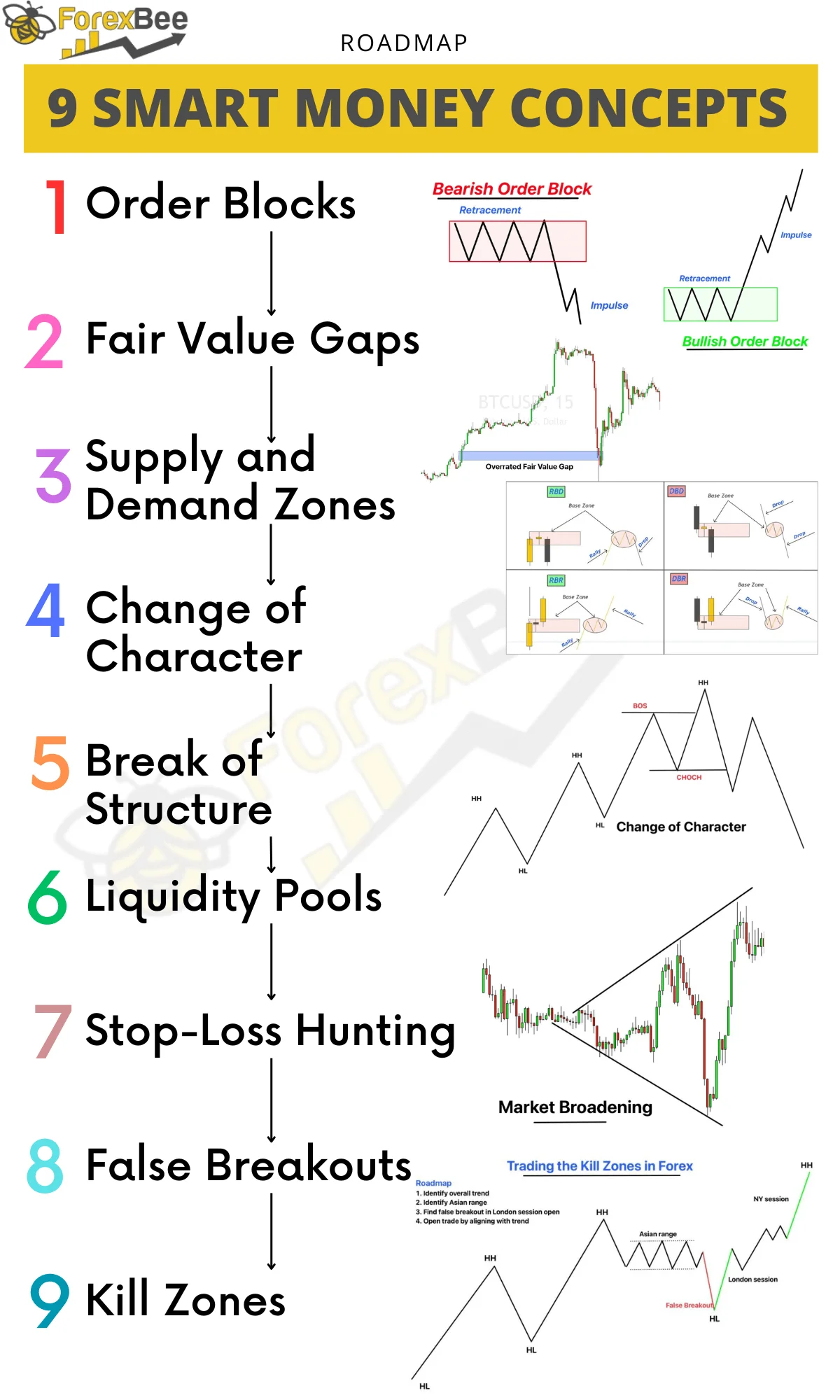
SMC is a broad community framework with overlapping terminology; exact definitions vary, so the trading rules must be stated explicitly.
// Lesson Content
SMC and ICT share concepts such as market structure, liquidity, order blocks, fair value gaps and displacement. ICT refers to the specific teaching associated with Michael J. Huddleston, while SMC is a broader community label used by many educators.
Do not assume two traders mean the same thing when they use the same term. Define the exact swing, candle, range and confirmation rules in your own plan.
📌 The biggest practical difference is often terminology and source lineage. Always define the rule instead of relying on the label.
Supply and demand zones are broad price areas where traders expect prior imbalance between buyers and sellers to matter again. They are not proof of resting institutional orders.
A useful zone definition should include its origin, the displacement that followed, the timeframe, the invalidation condition and whether the zone has already been mitigated.
📌 Avoid drawing dozens of zones. A zone needs a consistent definition and an objective invalidation rule.
An SMC order block is commonly described as a candle or small range before a strong directional move. Different educators define the qualifying candle differently.
For testing, define:
• Which candle qualifies
• Minimum displacement condition
• Whether a liquidity event is required
• Entry location
• Invalidation
• Target
Do not call every opposite-colored candle an order block.
📌 The term “order block” does not prove that a specific institution placed an order at that candle.
BOS (Break of Structure) is commonly used to describe a break supporting the current structural direction. CHoCH (Change of Character) is commonly used for a break suggesting a change in short-term behavior.
The terminology varies. Your test should state which swing must break, whether a candle close is required and which timeframe controls the decision.
📌 Define your BOS and CHoCH rules before the chart outcome. Otherwise the same move can be labeled differently after the fact.
Inducement is commonly used for a price feature that attracts traders before a larger move. Because intent cannot be observed directly, use it as a chart hypothesis rather than a statement about what participants were thinking.
A complete SMC workflow can be written as:
1. Higher-timeframe context
2. Liquidity reference
3. Structure condition
4. Setup zone
5. Entry trigger
6. Invalidation
7. Target
8. Risk and review rules
Every component should be testable independently.
📌 SMC becomes a system only when context, setup, trigger, invalidation, target and risk are all written as rules.
// Test Your Understanding
// KNOWLEDGE CHECK
1. What is SMC in common trading usage?
2. What should be defined when testing an SMC order block?
3. What is a key difference between BOS and CHoCH terminology?
// What to study next
Continue your ICT journey