Advanced📖 40 min🏷 ICT
SMT DIVERGENCE
SHARE FREE:
Correlated markets, intermarket divergence and confirmation
ICT Flow EditorialIndependent educational resource
This lesson explains concepts commonly taught in ICT/SMC trading education and presents them as frameworks to study and test. Chart patterns cannot independently prove institutional intent, future price delivery, or profitability. Examples and rules are educational, not trading advice.
Read our editorial standards →SMT (Smart Money Technique) divergence is an ICT concept based on comparing correlated instruments. The idea is simple: when two normally related markets reach a comparable swing area but one makes a new extreme and the other does not, traders may treat the non-confirmation as context. Divergence alone does not predict the next move.
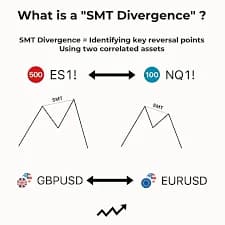
SMT divergence compares related markets to identify a non-confirmation; it is a contextual signal, not proof of institutional activity.
// Lesson Content
Start with two markets that have a defensible relationship, such as EURUSD and GBPUSD or NAS100 and S&P 500.
Mark comparable swing highs and lows on both charts. A bullish SMT example occurs when one market makes a lower low while the correlated market fails to make a corresponding lower low. A bearish example is the inverse.
The key is comparison: both markets must be viewed over the same relevant time window and swing definition.
📌 SMT is a non-confirmation between related markets. It is not proof that institutions are buying or selling at a specific level.
Intermarket SMT extends the same comparison idea across related asset classes or indices. Examples may include major FX pairs, US equity indices, or instruments with a commonly observed inverse relationship such as gold and the dollar.
Correlation is not constant. It can weaken or change with market regime, news and timeframe. Record the relationship you are using instead of assuming it will always behave the same way.
📌 Correlation must be validated for the instrument pair, timeframe and period being tested.
For index traders, NAS100 and S&P 500 are a common pair to study. Compare equivalent swing points rather than simply comparing whether one chart is higher or lower.
A practical workflow:
1. Establish the higher-timeframe level or liquidity reference.
2. Mark the corresponding swing on both indices.
3. Check whether one index breaks the prior extreme while the other does not.
4. Wait for your separate entry model if SMT is only a confirmation filter.
5. Define invalidation independently of the divergence.
📌 SMT should usually be a confluence or filter, not the complete entry model.
An SMT divergence becomes more useful for testing when combined with a clearly defined setup such as a liquidity sweep, market-structure shift or FVG.
Do not enter simply because divergence appeared. Your plan should specify:
• The correlated instruments
• The swing definition
• The timeframe
• The confirmation required after SMT
• Stop placement
• Target
• When the divergence is considered invalid
This makes the idea measurable instead of discretionary.
📌 Separate the SMT signal from the entry trigger. This lets you test whether SMT actually adds value to the base strategy.
Daily SMT and intraday SMT answer different questions. Higher-timeframe divergence can provide broader context, while intraday divergence may help with a specific session setup.
Keep the timeframe fixed during a test. Avoid switching to a lower timeframe after the trade begins simply because it produces a cleaner divergence. That introduces hindsight bias.
📌 Test daily and intraday SMT separately. Mixing definitions makes it difficult to know what actually contributed to the result.
// Test Your Understanding
// KNOWLEDGE CHECK
1. What is the core idea behind SMT divergence?
2. SMT divergence by itself should be treated as...
3. What should remain consistent during an SMT test?
// What to study next
Continue your ICT journey