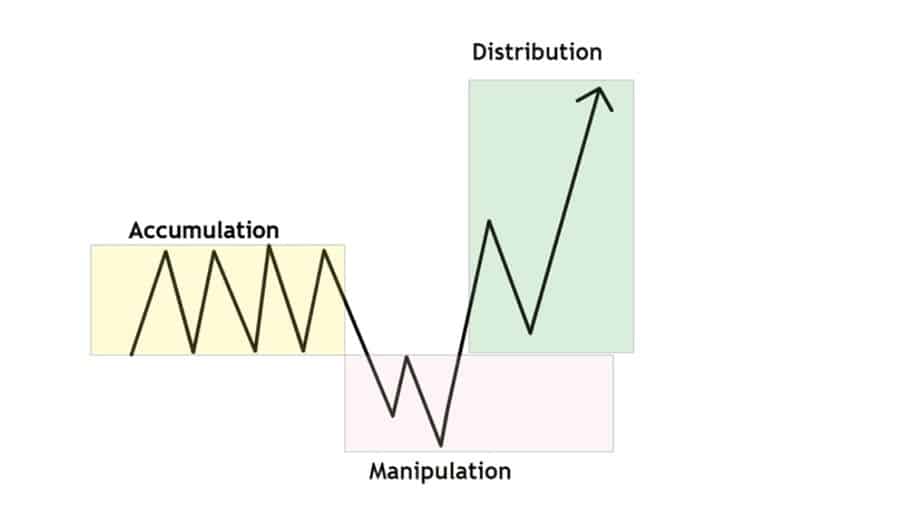
ICT Power of Three (AMD): Interpreting Session and Candle Ranges
Review how traders use the Power of Three framework to label possible accumulation, manipulation and distribution phases, and test a fixed definition without assuming every session follows the sequence.
Framework note: ICT terms are interpretations of price action, not proof of institutional motives or a market algorithm’s intent. No setup is guaranteed. Test clearly defined rules, account for costs and slippage, and use risk limits before risking capital. Read our editorial policy.
The Power of Three, also called the AMD Model (Accumulation, Manipulation, Distribution), is an ICT framework some traders use to classify selected ranges or sessions. Not every candle or session forms all three phases, and a label does not establish deliberate orchestration.
Phase 1: Accumulation — Building the Position
Within the AMD framework, traders may label a consolidation as an accumulation phase. The chart alone does not confirm that institutions are building positions or that the range was deliberate; define criteria in advance and record cases that do not fit.
The Accumulation phase on a daily timeframe typically corresponds to the Asian session — where price oscillates within the Asian Range while European and American institutions are preparing their orders. On a weekly basis, Monday is often the Accumulation day. On a monthly basis, the first week is often the Accumulation week.
Phase 2: Manipulation — Engineering the False Move
Some ICT traders use the term manipulation for a move through a reference level before a later move in the opposite direction. A chart does not show that retail traders were deliberately trapped or that institutions needed to clear opposing orders; define the sequence before testing it.
For a bullish AMD hypothesis, a trader may define an early move below a selected low followed by a later move higher. That observed sequence does not prove that institutions intentionally pushed price lower to generate sell orders; also record days that continue lower or never reverse.
The Manipulation phase on a daily timeframe corresponds to the London session — the most deceptive session of the day. During London, a Judas Swing frequently sweeps either the Asian High or Asian Low before the day's real direction is established. On a weekly basis, Tuesday is often the Manipulation day — creating a false move against Monday's direction before the week's primary trend develops.
Phase 3: Distribution — Delivering to the Target
The Distribution phase is when institutions deliver price to their target — the external liquidity level (ERL) that has been the objective since the Accumulation phase began. During Distribution, price moves decisively in one direction with clear displacement — large-bodied candles, FVGs embedded in the move, and minimal retracement against the trend.
The Distribution phase on a daily timeframe corresponds to the New York AM session — the primary delivery window. On a weekly basis, Wednesday through Thursday are typically the Distribution days where the week's primary trend is delivered. On a monthly basis, the middle weeks of the month are typically the Distribution phase.
Reading the Daily Candle as an AMD Structure
Some traders use AMD to interpret daily price action, but its phases are subjective labels and cannot prove who traded or why price moved. The Open of the daily candle is not random — it is the starting reference point for the day's entire delivery sequence. ICT uses the "True Daily Open" — midnight New York time — as the reference rather than the exchange open.
- Bullish AMD Day: Opens near the low (accumulation), Manipulation moves lower into SSL (sweeping stop losses of longs), Distribution delivers to BSL target above — candle closes near its high
- Bearish AMD Day: Opens near the high (accumulation), Manipulation moves higher into BSL (sweeping stop losses of shorts), Distribution delivers to SSL target below — candle closes near its low
- The body of the daily candle represents the real move; the wicks represent the manipulation phases
- The bigger the wick in one direction, the more liquidity was swept during that phase — higher quality manipulation equals cleaner distribution
AMD on Higher Timeframes — Weekly and Monthly
The AMD model fractal nature is one of its commonly discussed characteristics. The same three-phase pattern that describes a single day also describes an entire week, and a week's pattern describes an entire month, and a month's pattern describes a quarter. ICT teaches traders to read AMD on multiple timeframes simultaneously to understand where the market is in its delivery cycle at any given moment.
A trader who understands that we are in the Distribution phase of a weekly AMD cycle (Wednesday-Thursday delivery to an external target) will not be confused when daily charts show manipulation moves against the trend — they understand those daily manipulations are simply the internal AMD cycles within the larger weekly distribution.
Practice identifying AMD on completed daily candles first. Look at yesterday's candle: where did it open? Did it make a false move in one direction early? Then where did it close? Once you can consistently identify AMD in completed historical candles, begin watching for the pattern in real time.
Worked hypothetical example: label an AMD sequence
Before a session, a learner marks a pre-session range from 100 to 102. Price first consolidates in the band, briefly trades to 102.3, returns below 102, and later falls to 99.6. Under a predefined rule this may be recorded as accumulation, a failed upside break and a downside expansion. Those labels describe the observed path; they do not establish that the sequence was planned or that the same order must repeat.
Failure case and what to test
Some sessions break the range and continue without returning; others expand both ways or remain balanced. Test a fixed range, crossing threshold and time horizon. Avoid identifying the phases only after seeing the full day's high and low.
Test checklist
- Define the range-building period and minimum duration.
- Set manipulation/sweep and expansion criteria before the session.
- Classify continuation, two-sided expansion and non-expansion cases.
- Test across separate time periods, instruments and realistic trading costs.
RELATED READING
Continue with guides selected for overlapping concepts and practical context.