ICT vs SMC: Comparing Terminology, Frameworks and Evidence
Compare commonly used ICT and Smart Money Concepts terminology, note where definitions overlap or differ, and distinguish each framework's explanations from independently verified market mechanics.
Framework note: ICT terms are interpretations of price action, not proof of institutional motives or a market algorithm’s intent. No setup is guaranteed. Test clearly defined rules, account for costs and slippage, and use risk limits before risking capital. Read our editorial policy.
If you are new to institutional trading, you have probably seen two terms everywhere: ICT and SMC. Traders argue about which is better, which came first, and whether they are even different. This guide settles the debate with facts, history, and practical advice.
What is ICT?
ICT stands for Inner Circle Trader and refers to educational material associated with Michael J. Huddleston. Its descriptions often interpret price action through liquidity, structure and institutional-market concepts; the framework's language does not independently verify who moved price or why.
What is SMC?
Smart Money Concepts (SMC) is a broad label used for chart-based trading frameworks that borrow concepts associated with institutional activity. Different educators use different definitions, and the term does not mean a trader can directly observe or replicate institutional positions from candles.
The Key Differences
ICT was founded by Michael J. Huddleston in the early 2000s. SMC evolved from the community around 2015-2020. ICT uses institutional language (banks, algorithms), while SMC uses mechanical language (zones, levels, setups). ICT has heavy time emphasis -- killzones, macro times -- whereas SMC is more moderate. ICT complexity is higher with deeper theory; SMC is simplified for beginners. ICT offers extensive free content on YouTube; SMC courses are often paid.
The Similarities (Why They Are Often Confused)
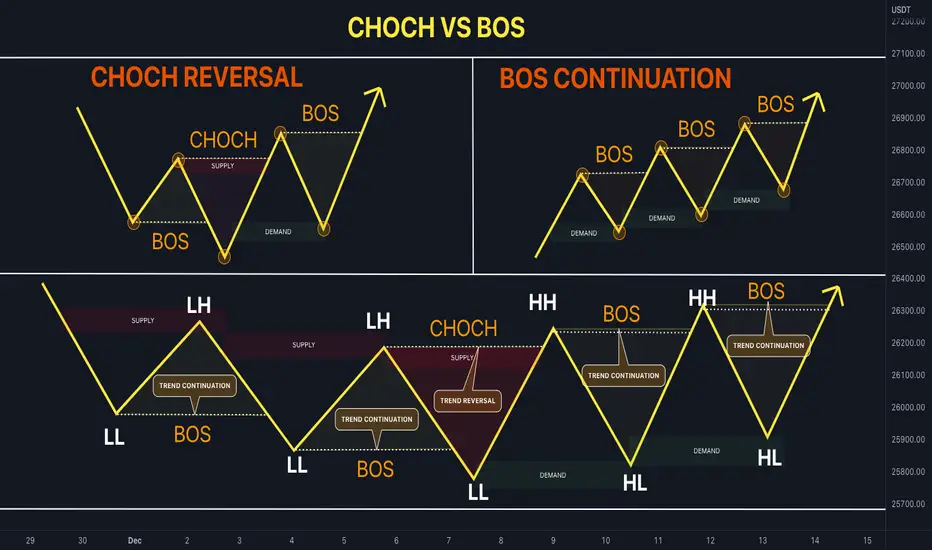
ICT and SMC materials often discuss overlapping ideas such as swing structure, order-block zones, gaps and liquidity references. Similar terminology does not prove the zones contain institutional orders or that price is targeting retail stops; compare operational definitions rather than treating the frameworks as identical.
Which One Should You Learn?
Choose ICT if you want to understand the why behind price movement, enjoy deep complex concepts, want free comprehensive education, and plan to trade professionally long-term. Choose SMC if you want to start trading quickly with simpler concepts, prefer mechanical rules over theory, or are overwhelmed by ICT complexity.
The Best Approach: Learn Both. Most successful traders eventually learn both ICT and SMC. They are not competitors -- they are complementary perspectives on the same market reality. Start with ICT fundamentals (free on YouTube), apply SMC simplification for quick execution, then deepen with advanced ICT concepts.
Common Myths Debunked
Myth: ICT is a scam. Reality: ICT has been teaching for 20+ years with thousands of successful students. The free content alone is more comprehensive than most paid courses. Myth: SMC is just ICT repackaged. Reality: While SMC evolved from ICT, it has developed unique concepts and simplifications. Myth: You must choose one. Reality: The best traders use concepts from both. Market structure is market structure regardless of the label.
Conclusion
ICT and SMC are two paths to the same destination: understanding how institutional traders move price and using that knowledge to trade profitably. ICT is the university degree -- deep, theoretical, comprehensive. SMC is the trade school -- practical, simplified, application-focused. Neither is better. The best choice depends on your learning style, goals, and personality.
Worked hypothetical example
A student reviewing the same chart might use ICT terms such as dealing range, FVG and session window, while another describes a swing break, supply/demand zone and liquidity. Put both analyses beside each other and ask which observable rules differ: zone boundaries, entry trigger, invalidation, timing or target. The vocabulary alone does not prove one approach is better.
Failure case and what to test
Treating ICT and SMC as completely separate systems can create artificial distinctions because educators use overlapping terms differently. The reverse mistake is assuming all methods are identical without comparing their rules.
Test checklist
- Compare rules and examples, not just terminology.
- State what each framework adds to an actual trade decision.
- Judge claims using the same dataset, costs and risk assumptions.
RELATED READING
Continue with guides selected for overlapping concepts and practical context.