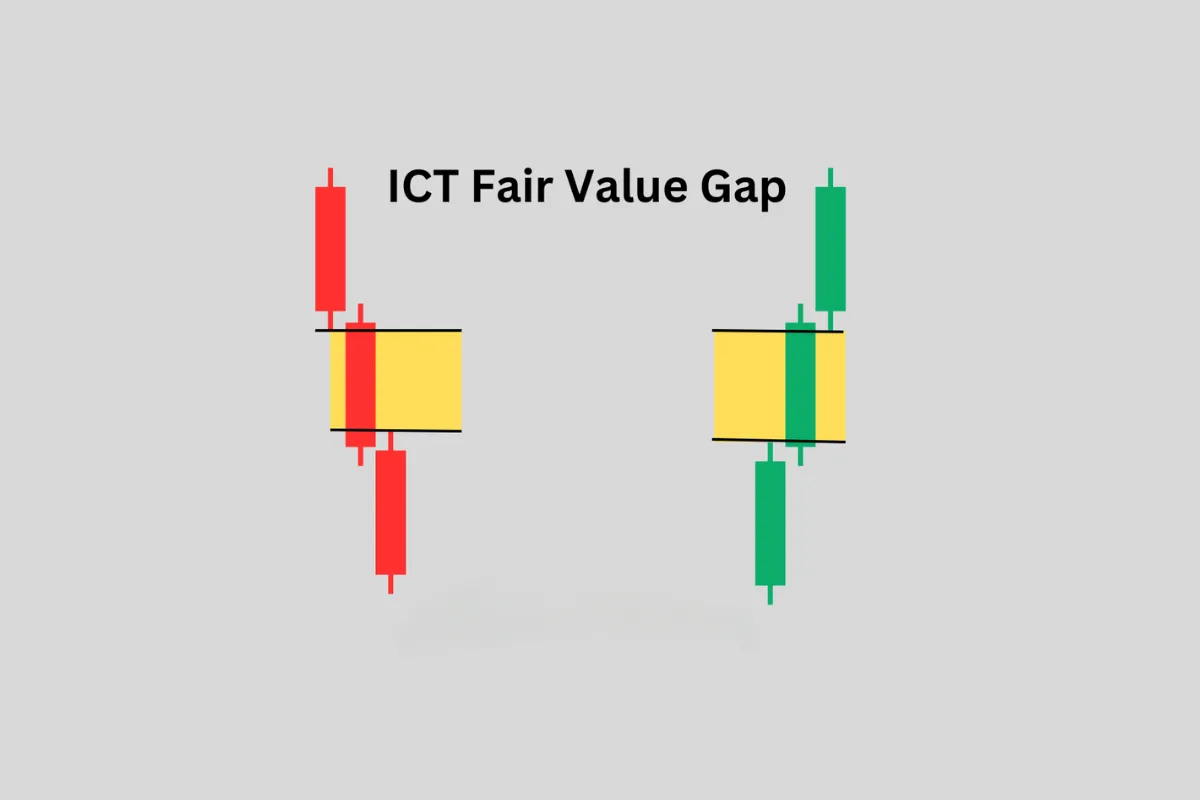
ICT Fair Value Gaps: Criteria for Classifying and Testing Setups
Review how traders identify a three-candle imbalance, document context and invalidation, and compare outcomes across every qualifying example rather than labelling winners valid after the fact.
Framework note: ICT terms are interpretations of price action, not proof of institutional motives or a market algorithm’s intent. No setup is guaranteed. Test clearly defined rules, account for costs and slippage, and use risk limits before risking capital. Read our editorial policy.
FVGs are not all interchangeable, but calling one valid needs a written definition. A three-candle imbalance can be tagged by size, displacement, timeframe or location; none of those labels alone demonstrates institutional significance or guarantees a reliable reaction.
Criterion 1 — The Displacement Requirement
A displacement filter can be defined using measurable candle-size or overlap rules. Set thresholds before reviewing the sample and use the same values across all eligible examples; visual impressions of aggressive movement can otherwise become hindsight selection.
The test: look at the candle sequence that created the FVG. Are the candles large-bodied? Do they show directional conviction? Is there a noticeable increase in momentum compared to the surrounding price action? If yes — genuine displacement, valid FVG. If no — the FVG is noise.
Criterion 2 — Higher Timeframe Alignment
A valid FVG must align with the institutional order flow on the higher timeframe. A bullish FVG on the 5-minute chart is only valid if the 4-hour or daily chart shows a bullish institutional order flow. Trading a bullish 5-minute FVG in a bearish 4-hour structure is one of the most common causes of FVG trade failures.
Before trading any FVG, ask: what is the direction of the nearest 4-hour OB or FVG? What is the daily bias? Does this 5-minute FVG point in the same direction? Only if the answer is yes to both questions is the FVG alignment sufficient for a high-probability entry.
Criterion 3 — The First FVG in the Sequence
When a displacement move creates multiple FVGs within the same sequence, only the first one — the 1st Presented FVG — carries full institutional significance. The first FVG represents the first opportunity for the market to reprice the imbalance. Subsequent FVGs within the same displacement have progressively lower probability because the same institutional interest that created the earlier FVGs is diminishing with each one.
Criterion 4 — No Prior Violations
A valid FVG must not have been previously violated. Once price has traded fully through an FVG — through both the near edge and the far edge — the FVG has been mitigated. A fully mitigated FVG is no longer a valid entry zone. It may have become an Inversion FVG (a zone that has flipped from support to resistance or vice versa), but the original bullish or bearish character has been extinguished.
- Check: has price previously entered the FVG and traded through more than 50% of the gap? If yes, the FVG is partially mitigated and carries less weight.
- Check: has price traded through the full FVG (from near edge to far edge) at any point? If yes, the FVG is fully mitigated and should not be traded in its original direction.
- Check: has the FVG become an Inversion FVG? If price has traded completely through it, it may have flipped — in which case the original FVG zone now acts in the opposite direction.
Criterion 5 — Session Timing
Valid FVGs for intraday entries should be created and tested during active sessions — London and New York. An FVG created during the Asian session low-volume period or during a bank holiday has less institutional significance because the institutional participation required to create a genuine imbalance was not present at the time of creation.
Create a checklist for every FVG you consider trading: (1) Was it created by a genuine displacement? (2) Does it align with the HTF bias? (3) Is it the first FVG in the displacement sequence? (4) Has it been previously violated? (5) Was it created during an active session? Only FVGs passing all five criteria qualify for trade consideration.
Worked hypothetical example: screen an FVG with fixed criteria
A trader sets a minimum FVG width of 0.25 ATR and requires the middle candle's true range to exceed a predefined threshold. A three-candle formation qualifies only if the first and third candle extremes create the required interval and a nearby close meets the confirmation rule. A narrower gap is skipped under the written rule, even if it later produces a visually attractive bounce.
Failure case and what to test
Changing minimum width, displacement, timeframe or context can produce very different samples. A selected gap may fail to react or never be revisited. Compare the filter to unfiltered FVGs and avoid describing a gap as valid solely because its eventual path looks successful.
Test checklist
- Set minimum width and displacement rules before sampling.
- Define which context filters are mandatory and how they are measured.
- Log every qualifying gap, not only those later touched.
- Report rejected entries, failed reactions and results after costs.
RELATED READING
Continue with guides selected for overlapping concepts and practical context.