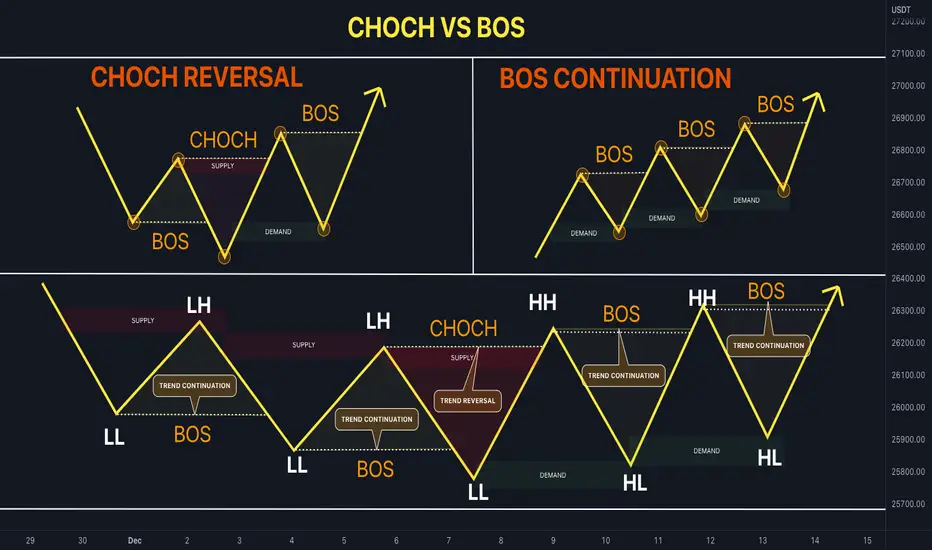
ICT Swing Highs and Lows: Confirmation Rules for Structure
Learn a consistent rule for identifying swing pivots and classifying their context, while accounting for confirmation delay and avoiding retrospective relabeling based on later price action.
Framework note: ICT terms are interpretations of price action, not proof of institutional motives or a market algorithm’s intent. No setup is guaranteed. Test clearly defined rules, account for costs and slippage, and use risk limits before risking capital. Read our editorial policy.
Swing highs and lows are local price pivots used in ICT chart analysis. Many structure concepts refer to such pivots, but identifying one depends on the chosen rule and timeframe; it does not by itself determine trend direction or the next liquidity target.
The ICT Swing High Definition
A swing high in ICT terms is a candle (or bar) whose high is higher than the high of the candle to its left AND higher than the high of the candle to its right. Minimum requirement: one lower high on each side. This creates the classic three-candle swing high: a candle with a lower high, followed by the swing high candle, followed by another candle with a lower high.
Using more confirming candles can delay the point at which a swing is recognized and can produce a different set of pivots. It does not mean that more candles prove a larger liquidity pool or greater market significance; test each definition consistently.
The ICT Swing Low Definition
A swing low is the mirror: a candle whose low is lower than the low of the candle to its left AND lower than the low of the candle to its right. One higher low on each side is the minimum. Like swing highs, more confirming candles on each side = more significant swing low.
Why Precision Matters
- If you misidentify a swing high, your BOS and ChoCH calls will be wrong — leading to incorrect bias and incorrect entries.
- Swing highs are where buy-side liquidity accumulates. If your swing highs are wrongly placed, your BSL levels are wrong, your liquidity pool targets are wrong, and your Turtle Soup setups are based on false levels.
- Order Blocks are identified relative to swing extremes — the last opposing candle BEFORE the swing. Wrong swing = wrong OB.
- The equilibrium (50%) of any range requires correct swing identification as the anchor points. Wrong swings = wrong premium/discount zones.
- On the 5-minute chart, use the minimum definition (one confirming candle on each side) for precision entries. On the daily chart, use 3-5 confirming candles on each side for structural significance.
Fractal Swing Highs and Lows
ICT teaches that swing highs and lows are fractal — the same structures appear on every timeframe. A 5-minute swing high is a minor structural point within a 1-hour swing that is itself within a daily swing. The significance of each swing is proportional to the timeframe on which it forms: daily swing highs are major structural levels with large liquidity pools; 5-minute swing highs are minor structural points for entry timing only.
Understanding the fractal nature of swings is what allows ICT top-down analysis to work: you identify the major swing high on the daily (the ERL target), the intermediate swing on the 4-hour (the retracement boundary), and the minor swing on the 15-minute (the entry trigger). Each timeframe's swings are valid at their own level of significance.
Exercise: on a clean chart with no indicators, mark every swing high and swing low using the strict ICT definition (one confirming candle on each side minimum). Then classify each one as STH/STL, ITH/ITL, or LTH/LTL based on the three-tier hierarchy. Repeat this on 20 different charts across multiple timeframes. Within two weeks, swing identification will be automatic and your entire structural analysis will become significantly more accurate.
Worked hypothetical example
A trader chooses a three-candle swing rule: the middle candle must have a higher high than the candles directly before and after it. A new high appears, but the following candle has not closed yet, so the swing remains provisional. The trader waits until the prewritten rule is satisfied before using the level in a liquidity or structure analysis.
Failure case and what to test
Different lookback sizes, wick-versus-close rules and real-time versus confirmed pivots can produce different swing maps. A swing may also be obvious in hindsight but unavailable for a live decision until later candles form.
Test checklist
- Document the pivot and confirmation rule, including timeframe.
- Avoid changing the rule between winners and losers.
- Record how much delay confirmation introduces to an entry or alert.
RELATED READING
Continue with guides selected for overlapping concepts and practical context.