ICT STL, ITL and LTL: Rules for Swing Classification
Review short-, intermediate- and long-term swing labels as a classification framework, define lookback and confirmation rules, and avoid inferring order locations or trend commitment from the labels alone.
Framework note: ICT terms are interpretations of price action, not proof of institutional motives or a market algorithm’s intent. No setup is guaranteed. Test clearly defined rules, account for costs and slippage, and use risk limits before risking capital. Read our editorial policy.
One of the commonly discussed and underappreciated aspects of ICT market structure is the classification of swing highs and lows into three tiers of significance. Short Term Highs/Lows (STH/STL), Intermediate Term Highs/Lows (ITH/ITL), and Long Term Highs/Lows (LTH/LTL) each represent different levels of liquidity accumulation and different degrees of structural significance. Understanding this three-tier hierarchy transforms how you read structure and how you identify which levels actually matter.
Short Term Highs and Lows (STH/STL)
A Short Term High (STH) is a swing high with at least one lower high on either side. A Short Term Low (STL) is a swing low with at least one higher low on either side. These are the smallest structural swing points — they represent the most recent minor turning points and form frequently, often multiple times per session on the 15-minute chart.
Short-term highs and lows are local pivots under a chosen swing rule. Some traders treat them as possible liquidity references, but their labels do not reveal the orders placed there or whether a later break reflects institutional activity.
Intermediate Term Highs and Lows (ITH/ITL)
An Intermediate Term High (ITH) is a swing high with at least one STH on either side — meaning it is a larger structural point with at least one smaller swing flanking it on both sides. Similarly, an Intermediate Term Low (ITL) has at least one STL on either side. ITHs and ITLs represent more significant turning points with larger accumulations of liquidity.
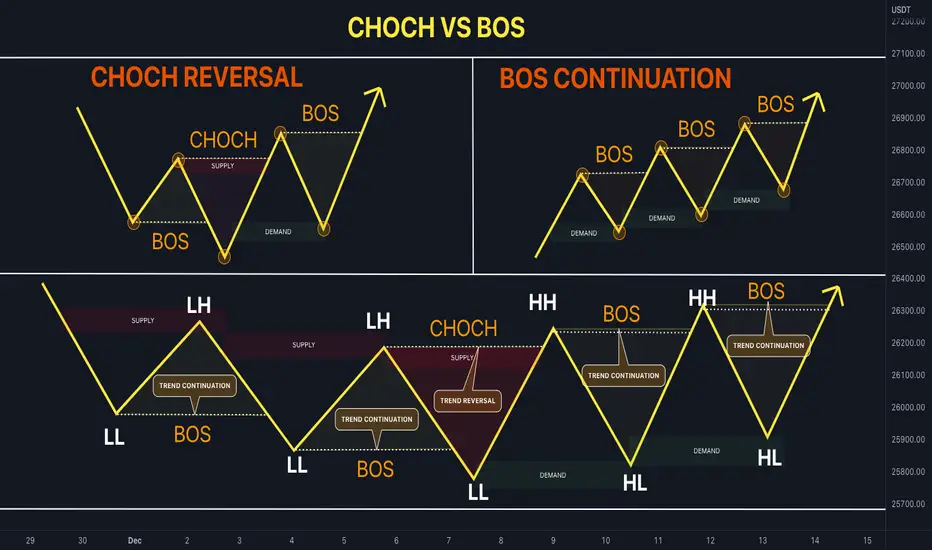
When an ITH or ITL is broken, it represents a more meaningful structural shift. A break of an ITH in a bearish structure suggests the bears are losing their grip and a potential reversal or significant retracement is underway. ITH and ITL breaks are what ICT refers to as Change of Character (ChoCH) events on the relevant timeframe.
Long Term Highs and Lows (LTH/LTL)
Long Term Highs and Lows are the major swing extremes on the chart — the highs and lows that define the primary trend. An LTH has at least one ITH on either side; an LTL has at least one ITL on either side. These levels represent the largest concentrations of liquidity on the chart and the most significant structural boundaries.
A break of a long-term high or low can be recorded as a structural event on the selected timeframe. It does not establish institutional commitment to a new direction; specify whether the rule uses a wick or close and track failed breaks too.
Using the Three-Tier Structure in Analysis
- When the algorithm breaks an STL while maintaining ITL and LTL intact, it is likely just collecting minor sell-side liquidity before continuing bullish — do not interpret it as a reversal.
- When the algorithm breaks an ITL while LTL remains intact, a deeper retracement is underway — trade the retracement, but the primary trend may still be intact.
- When the algorithm breaks an LTL, the primary trend is potentially reversing — this warrants a complete re-analysis of the chart from scratch.
- Use STH/STL to time your entries within the trend. Use ITH/ITL to identify your retracement targets. Use LTH/LTL to define your trade's ultimate target.
- The confluence-based ICT entries buy above a broken STL (bullish bias), targeting the nearest ITH. They sell below a broken STH (bearish bias), targeting the nearest ITL.
Practice identifying all three tiers on a daily chart of any instrument for 30 consecutive days. Mark each swing high and low and classify it as STH/STL, ITH/ITL, or LTH/LTL. Over time, you will develop an intuitive sense for the hierarchy of any price chart — and you will never again be fooled by a minor stop hunt that temporarily breaks a Short Term Low into thinking the trend has reversed.
Worked hypothetical example
A trader labels a confirmed five-minute pivot as a short-term reference, then checks whether a higher-timeframe swing rule also classifies the same area as intermediate-term. The pivot does not qualify under the larger lookback, so only the short-term label is retained. The classification is fixed before any later sweep or reaction occurs.
Failure case and what to test
The time horizon and exact swing requirements can vary across teaching sources. Applying labels after seeing which level price respects can make the hierarchy appear predictive when it may simply describe the chart retrospectively.
Test checklist
- Document the rule and timeframe for each swing tier.
- Mark pivots using only data available at the chosen confirmation point.
- Test whether the tiers improve decisions beyond a single consistent swing rule.
RELATED READING
Continue with guides selected for overlapping concepts and practical context.