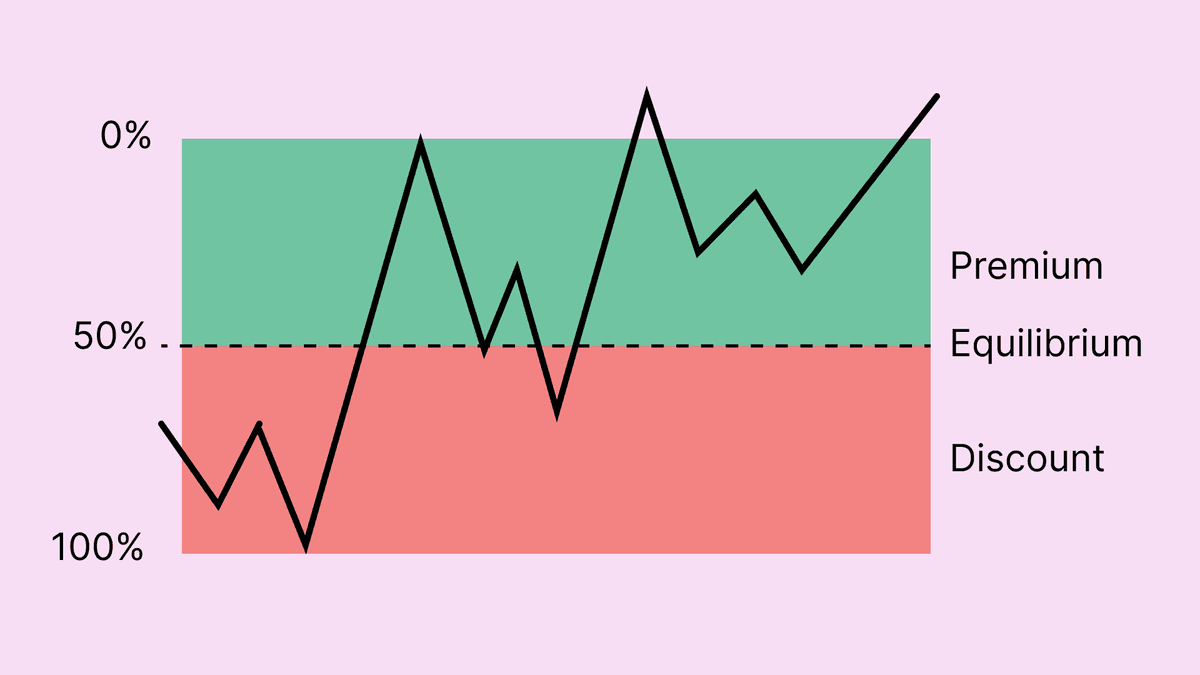
ICT Premium and Discount Zones: Range Location and Entry Context
Learn how a chosen dealing range is divided around equilibrium and why being in premium or discount alone does not establish direction or justify an entry.
Framework note: ICT terms are interpretations of price action, not proof of institutional motives or a market algorithm’s intent. No setup is guaranteed. Test clearly defined rules, account for costs and slippage, and use risk limits before risking capital. Read our editorial policy.
The ICT Premium and Discount framework is elegantly simple: institutions only buy when prices are cheap (discount) and only sell when prices are expensive (premium). If you are buying in premium or selling in discount, you are on the wrong side of the institutional order. This single principle, consistently applied, eliminates the majority of the bad trades that retail traders make — chasing entries at extended prices that institutions are actively selling into.
Defining Premium and Discount
To determine premium and discount, you need a reference range. In ICT, the reference range is drawn from the most recent significant swing low (the 0% level) to the most recent significant swing high (the 100% level). The 50% midpoint of this range is the equilibrium — the fair value price.
Everything above the 50% level is premium — the upper half of the range where prices are expensive relative to the range midpoint. Institutions sell in premium. Everything below the 50% level is discount — the lower half of the range where prices are cheap relative to equilibrium. Institutions buy in discount.
The Simple Application
- Identify your reference range: the most recent significant swing low to swing high on your working timeframe.
- Draw a horizontal line at the exact 50% midpoint of this range — this is your equilibrium level.
- In a bullish bias: only consider buy entries when price is below the 50% level (in discount). If price is above 50%, it is in premium — wait for a retracement to discount before buying.
- In a bearish bias: only consider sell entries when price is above the 50% level (in premium). If price is below 50%, it is in discount — wait for a rally to premium before selling.
- The OTE zone (62-79%) sits firmly in the discount half (for a bullish setup) and is the ideal entry point — deeply discounted within the range.
- Combine with PD Arrays: buy discount FVGs and OBs; sell premium FVGs and OBs. Never buy a premium FVG or sell a discount FVG.
Multiple Range Application
Premium and discount are fractal — they apply to every timeframe simultaneously. Price can be in discount on the weekly chart (below the weekly midpoint) but in premium on the daily chart (above the daily midpoint). ICT teaches that you should consider premium and discount at multiple timeframes: your entry should ideally be in discount on the HTF range AND in discount on the working timeframe range.
When both timeframes show your entry is in discount (for a long trade), you have double confirmation of favorable pricing. When the HTF shows discount but the LTF shows premium, wait — the LTF is overextended relative to its own range and a retracement to LTF discount will likely occur before the HTF continuation resumes.
Why Retail Traders Ignore Premium and Discount
Retail traders are trained to buy breakouts — to enter when price is making new highs, which by definition puts them in premium. They are trained to see recent strength as confirmation of direction. But every time a retail trader buys a breakout into premium, an institution is on the other side of that trade, selling their position at expensive prices. The premium and discount framework makes explicit why chasing breakouts is a losing approach: you are buying exactly where institutions are selling.
One practice that immediately improves trade selection: before every entry, draw the current dealing range on your chart, mark the 50% equilibrium, and ask "is my entry above or below the midpoint?" If you are long and your entry is above the midpoint, you are buying premium — reconsider. If you are long and your entry is below the midpoint, you are buying discount — proceed. This 10-second check will eliminate a large percentage of suboptimal entries.
Worked hypothetical example
A trader defines a dealing range from 100 to 110, making 105 its midpoint. Price at 103 lies in the lower half under that definition, but the trader still waits for the separately specified confirmation and invalidation. If price keeps falling, the location alone did not protect the trade.
Failure case and what to test
The result changes if swing anchors change, and a range selected after the move can make any price look cheap or expensive. Premium/discount is context within a chosen range, not proof of institutional valuation.
Test checklist
- Specify the dealing-range anchors and midpoint rule.
- Keep location separate from confirmation and entry criteria.
- Compare outcomes by range location without excluding failed or neutral cases.
RELATED READING
Continue with guides selected for overlapping concepts and practical context.