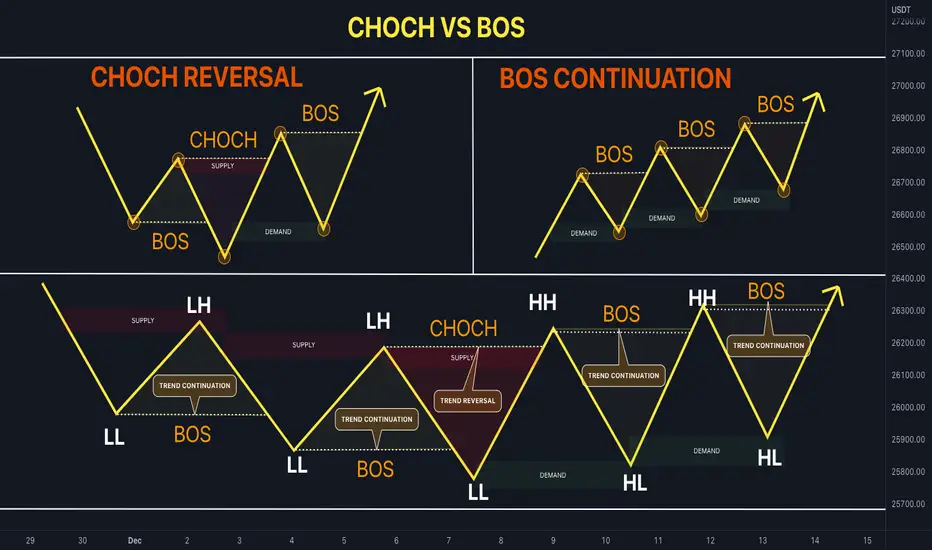
ICT MSS vs ChoCH: Structural Labels and Confirmation Rules
Compare how MSS and ChoCH are used in ICT education, define the swing and confirmation rule consistently, and separate chart structure from claims about algorithmic motive or a guaranteed trend change.
Framework note: ICT terms are interpretations of price action, not proof of institutional motives or a market algorithm’s intent. No setup is guaranteed. Test clearly defined rules, account for costs and slippage, and use risk limits before risking capital. Read our editorial policy.
The Market Structure Shift (MSS) and the Change of Character (ChoCH) are two structural shift concepts that are constantly confused by ICT students. They are related but distinct — they happen at different moments in the structural sequence, they have different implications for trade bias, and they are used at different timeframes for different purposes. Getting clear on both is essential for reading ICT market structure correctly.
Change of Character (ChoCH) — The First Warning
The Change of Character is the first structural event that suggests a trend may be losing momentum. In a bullish trend (Higher Highs and Higher Lows), a ChoCH occurs when price makes a Lower Low — it breaks below the most recent Higher Low that defined the uptrend. This is not yet a confirmed reversal; it is a warning that the character of price delivery has changed.
Under one convention, a ChoCH is marked when price breaks a selected swing against the prior structural sequence. The label indicates a structural change under that rule; it does not show what an algorithm intended or whether the break will develop into a lasting reversal.
Market Structure Shift (MSS) — The Confirmation
Some educators distinguish ChoCH as an earlier warning and MSS as a break of a more significant opposing swing. The terminology varies, so write down the reference swing and close rule and avoid treating either label as proof that the new direction is established.
A ChoCH and an MSS are labels for structural events under a chosen definition. Neither one proves that the prior trend has ended or that a new direction is established; keep the swing scope and confirmation rule consistent and record failed breaks.
Timeframe Application — How They Work Together
- On the Daily chart: a ChoCH is the first day that closes below a significant daily Higher Low. The MSS is the day that then breaks below the subsequent Lower High, confirming the daily structure has shifted bearish.
- On the 15-minute chart: the ChoCH is the first 15-minute candle that closes below the most recent 15-minute Higher Low (during a bullish setup). The MSS is the break of the subsequent lower high on the 15-minute.
- For trade entry: many ICT traders use the 5-minute MSS as their entry trigger — waiting for the lower timeframe MSS within an HTF PD Array zone is the CISD-based entry model.
- The ChoCH gives you the alert to watch for the trade. The MSS gives you the confirmation to execute the trade.
MSS vs ChoCH in the Entry Model
In a practical trade scenario: you have identified a bearish daily bias and are waiting for a retracement to a bearish 4-hour FVG. When price enters the 4-hour FVG zone, you switch to the 5-minute chart. On the 5-minute, you watch for a bullish ChoCH first (a minor pullback establishing a short-term higher low), then wait for the bearish MSS — the break of that minor high on the 5-minute — as your entry trigger. The 5-minute MSS within the 4-hour FVG is the complete entry signal.
Rule of thumb: trade the MSS, be aware of the ChoCH. The ChoCH puts you on alert; the MSS pulls the trigger. Never enter on a ChoCH alone — you need the MSS confirmation before committing capital. The number of traders who lose money entering on ChoCH alone, only to see price continue the original trend, is enormous. Wait for the MSS.
Worked hypothetical example
A trader defines ChoCH as a break against the immediate swing sequence and MSS as a break of a specific confirmed swing accompanied by displacement. On a sample chart, one move meets the first rule but not the second because the chosen displacement condition is absent. That case is recorded as a distinction under this trader’s rules, not a universal terminology standard.
Failure case and what to test
Educators do not always use MSS and ChoCH identically, so a definition borrowed from one source may conflict with another. Changing labels after seeing the next move can make a setup appear more accurate than it is.
Test checklist
- Name the source definition and timeframe before classifying charts.
- Write explicit wick/close, swing and displacement conditions.
- Keep a separate category for cases that do not fit either rule.
RELATED READING
Continue with guides selected for overlapping concepts and practical context.