ICT Market Structure Shift (MSS): Definitions, Confirmation and Limits
Learn how ICT traders define a break of selected swing structure, specify wick or close confirmation, and distinguish that observation from proof of a trend change or a complete entry plan.
Framework note: ICT terms are interpretations of price action, not proof of institutional motives or a market algorithm’s intent. No setup is guaranteed. Test clearly defined rules, account for costs and slippage, and use risk limits before risking capital. Read our editorial policy.
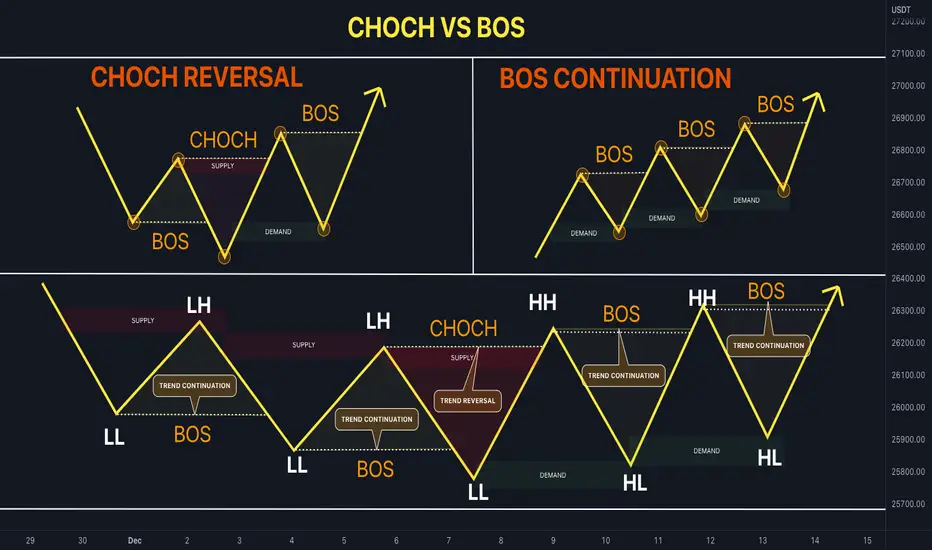
A Market Structure Shift (MSS) is an ICT term for a break of selected swing structure that traders may use as a directional signal. Definitions vary, and a structural break does not guarantee a trend reversal or continuation.
The Technical Definition of an MSS
Under one common ICT convention, a bullish MSS is labelled when price closes above a preselected short-term swing high. This is a structural observation under that definition, not proof that a bearish phase has ended or a bullish phase must continue.
A bearish MSS is the mirror: during a bullish move or after a liquidity sweep higher, price creates a candle that closes below the most recent short-term low (the last significant higher low formed during the bullish move). This close below the STL is the bearish MSS — bearish delivery has begun.
MSS in the Context of ICT Entry Models
Some traders combine a sweep hypothesis, displacement, a swing break and an FVG into an entry model. These are separate chart conditions, not confirmation of a hidden 'true' direction; define the sequence and invalidation in advance.
Waiting for a pre-defined MSS rule may reduce entries taken before a chosen swing break, but it does not eliminate failed trades or guarantee the next direction. Compare outcomes with and without the filter under the same execution assumptions.
The MSS Candle — What to Look For
- The MSS candle should be a displacement candle — large-bodied, minimal wick, clear directional conviction.
- The close of the MSS candle must be beyond the reference STH or STL — not just the wick, but the close.
- The MSS should create at least one FVG (imbalance) between the reference STH/STL and the MSS candle close.
- The MSS should occur during a Killzone or Macro window — low-volume MSS signals outside of these windows carry less institutional significance.
- A strong MSS has a candle body that is at least 50% of the distance between the reference level and the MSS candle close — a weak, barely-clearing MSS is less reliable than a strong, decisive one.
MSS on Multiple Timeframes
The MSS concept applies to every timeframe. A daily MSS represents a significant shift in the multi-day delivery direction. A 15-minute MSS represents an intraday shift appropriate for swing entries. A 5-minute or 1-minute MSS represents the precise entry trigger within a pre-identified HTF PD Array zone.
For intraday entries, use the 5-minute MSS as your trigger. The sequence: daily bias (HTF), 4-hour PD Array (entry zone), 5-minute MSS (entry trigger). The 5-minute MSS within a 4-hour OB or FVG is the complete ICT entry model — three timeframes aligned with a precise trigger.
An MSS can be one entry condition in a written plan; it is not a universal entry rule. Specify the timeframe, swing definition, close rule, risk, stop, target and expiry, and allow for trades where the signal fails or never appears.
Worked hypothetical example
In a hypothetical uptrend, a trader marks a recent confirmed higher low before a push to a new high. Price later closes below that higher low, meeting the trader’s written MSS rule. The break is logged as a possible change in short-term structure, but the trader still waits for a separate entry trigger and defined invalidation.
Failure case and what to test
The MSS label depends on which swing counts, whether wicks or closes qualify and how much displacement is required. A structural break can quickly reverse, and different definitions can make backtests incomparable.
Test checklist
- Define the reference swing and break condition before review.
- Separate the MSS label from entry, stop and target rules.
- Count false breaks and reversals rather than keeping only clean examples.
RELATED READING
Continue with guides selected for overlapping concepts and practical context.