Liquidity in Forex Trading — The ICT Perspective Explained
Liquidity in forex is not just a market concept — it is the engine that drives every significant price move. Understanding how liquidity works from the ICT perspective transforms how you see the entire market.
Framework note: ICT terms are interpretations of price action, not proof of institutional motives or a market algorithm’s intent. No setup is guaranteed. Test clearly defined rules, account for costs and slippage, and use risk limits before risking capital. Read our editorial policy.
Liquidity is the foundational concept beneath every single ICT trading strategy. Before you can understand Order Blocks, Fair Value Gaps, Killzones, or any other ICT tool, you must understand what liquidity is, where it exists in the market, and why institutional traders are constantly seeking it. Once you truly understand liquidity from the ICT perspective, you stop seeing random price movements and start seeing a deliberate, systematic algorithm pursuing specific pools of orders.
What Is Liquidity in the ICT Framework?
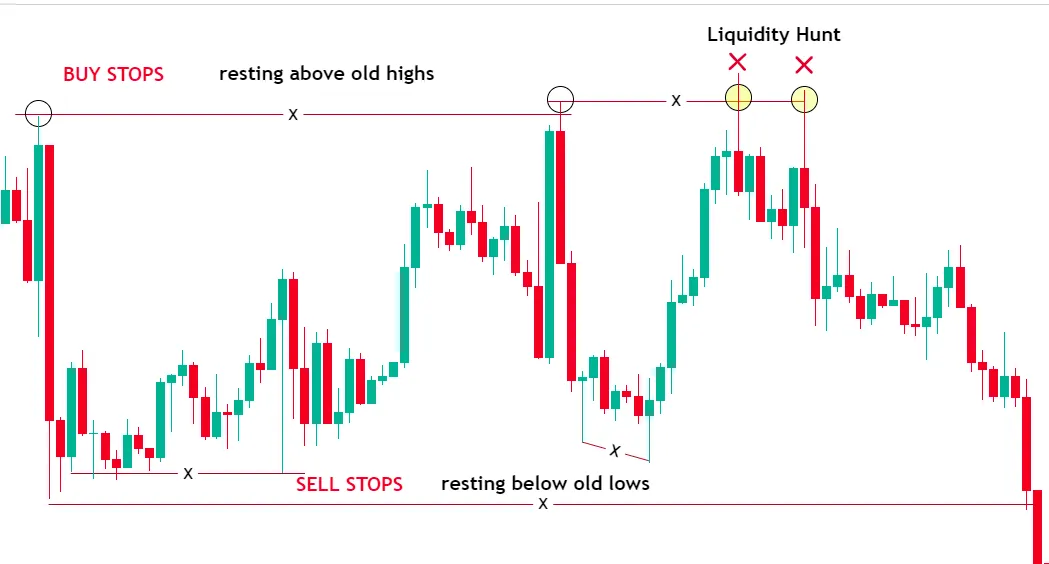
In traditional finance, liquidity refers to the ease with which an asset can be bought or sold without significantly affecting its price. In the ICT framework, liquidity specifically refers to the clusters of pending orders (stop losses and stop-entry orders) that accumulate at specific price levels above and below the market. These clusters are the liquidity that the algorithm seeks.
Every swing high has buy-stop orders clustered above it — from breakout traders waiting to enter long, and from short-sellers' stop losses protecting their positions. Every swing low has sell-stop orders clustered below it — from breakdown sellers and from long positions' stop losses. The more obvious and widely watched a swing level is, the more orders have accumulated there, and the more attractive it is as a liquidity target for the algorithm.
Buy-Side and Sell-Side Liquidity
Buy-Side Liquidity (BSL) sits above the market — above swing highs, equal highs, and previous session/week highs. When the algorithm needs to fill large buy orders, it drives price above BSL levels, triggering the sell-stop orders of short-sellers and the buy-stop orders of breakout traders. Both provide the liquidity for institutional selling at high prices.
Sell-Side Liquidity (SSL) sits below the market — below swing lows, equal lows, and previous session/week lows. When the algorithm needs to fill large sell orders (accumulate short positions), it drives price below SSL levels, triggering buy-stop orders of long-position holders and the sell-stop orders of breakout sellers. Both provide the liquidity for institutional buying at low prices.
Equal Highs and Equal Lows — The Most Visible Liquidity
Equal Highs (EQH) and Equal Lows (EQL) are the most obvious and therefore the most heavily targeted liquidity pools. When two or more swing highs are at approximately the same price level, every trader who looks at the chart will see those equal highs and place stop orders just above them. The concentration of stops at those levels makes equal highs a priority target for the algorithm.
- Mark equal highs and equal lows on your chart before every session — these are your primary liquidity pool targets.
- Expect price to take out equal lows before a bullish move (SSL sweep). Expect price to take out equal highs before a bearish move (BSL sweep).
- The more touches (the more times price tested the same level without breaking), the more liquidity has accumulated there, and the stronger the reaction after the sweep will be.
- Previous session high and low, previous week high and low, and previous month high and low are all significant liquidity pools that the algorithm targets regularly.
Liquidity as the Draw on Liquidity Target
Every ICT trade has a Draw on Liquidity (DOL) — the specific liquidity pool that price is being delivered toward. Before entering any trade, you must identify the DOL: which pool of liquidity is the algorithm targeting in the current session? Is it the previous week's high (BSL above) or the previous day's low (SSL below)? The DOL is your target, and all other ICT tools — OBs, FVGs, OTE zones — are simply the entry mechanisms for getting into the trade that delivers to the DOL.
Shift your mental model: stop thinking about price going "up" or "down" and start thinking about price going toward the nearest liquidity pool. Before every session, ask: "Where is the nearest significant liquidity pool — BSL above or SSL below?" The answer to that question is your daily target. Everything else is the path to reach it.
Worked hypothetical example: test a forex swing-level event
A trader marks the previous day's high on EUR/USD and defines a crossing as at least one pip above the level, followed by a 15-minute close back below it. When the event occurs, the trader records the next five-bar path using a predefined outcome such as continuation, reversal or range. This describes observed prices; it does not confirm the full order book or exact reasons for the move.
Failure case and what to test
Forex is fragmented across venues, and a broker's candle feed may differ from another's. Price can continue after crossing a swing, while spread expands around news. Test the rule on the same defined feed and session, with weekends, news and variable spread handled consistently.
Test checklist
- Name the currency pair, price feed, timezone and session.
- Define swing equality and crossing/close conditions.
- Record continuation and range outcomes as well as reversals.
- Include spread, commissions, slippage, news windows and a holdout sample.
RELATED READING
Continue with guides selected for overlapping concepts and practical context.