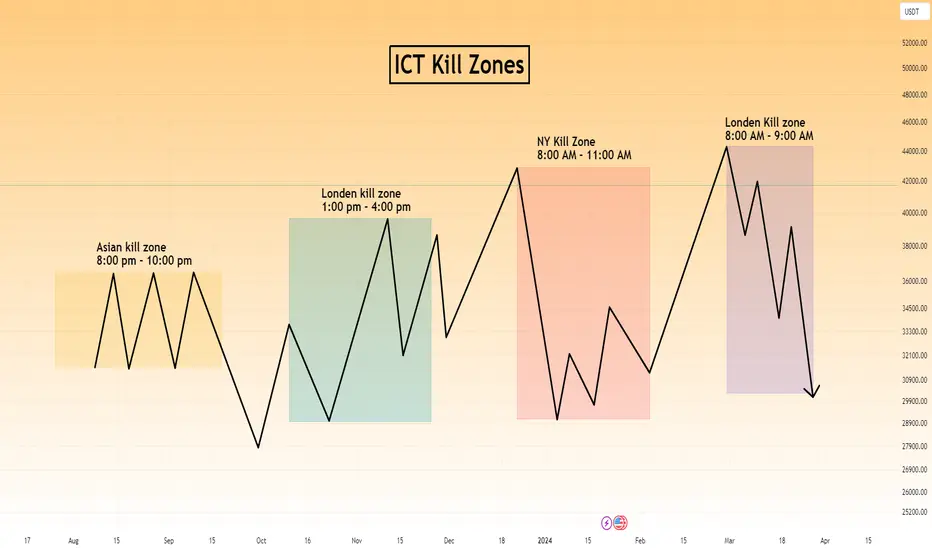
ICT Killzones Explained: London and New York Session Filters
Learn how ICT traders use London and New York session windows as observation filters, and how to test whether the timing adds value for a specific instrument and rule set.
Framework note: ICT terms are interpretations of price action, not proof of institutional motives or a market algorithm’s intent. No setup is guaranteed. Test clearly defined rules, account for costs and slippage, and use risk limits before risking capital. Read our editorial policy.
ICT Killzones are session windows that traders use to focus chart review. Liquidity and volatility can vary across sessions, but these windows do not guarantee cleaner price action or higher win rates. Test a time filter on your instrument, timeframe and rules.
Why Time Matters More Than Most Traders Think
Markets are not equally active throughout the 24-hour day. Liquidity ebbs and flows as different institutional centers open and close — Tokyo, London, New York. The overlapping periods between major sessions, and the opening of key sessions, are when the largest volume of institutional orders hit the market.
Understanding session timing transforms how you read price action. A setup that looks perfect at 3 PM New York time — well into the afternoon session — has a completely different probability profile than the same setup appearing at 10 AM during the primary New York distribution window. Time is context. Without it, you are trading patterns without understanding the conditions that make those patterns work.
Asian Session (7 PM – 12 AM EST) — Range Building
The Asian session is primarily a consolidation and range-building phase. Major institutions in Tokyo, Singapore, and Hong Kong participate during this time, but volume is significantly lower than during the London and New York sessions. Price typically oscillates within a defined range — the "Asian Range" — without strong directional commitment.
The Asian Range becomes critically important as a reference for the London session. The high and low of the Asian session are major liquidity pools — Buy-Side Liquidity above the high, Sell-Side Liquidity below the low. London traders will frequently target one or both of these levels as part of the Judas Swing manipulation before committing to the day's true direction.
London Killzone (2 AM – 5 AM EST) — The Manipulation Phase
The London Killzone is often the most deceptive period of the trading day. As European institutional traders come online, they bring enormous volume that frequently creates a false directional move — sweeping liquidity in one direction before reversing and establishing the real daily trend in the opposite direction.
The classic London session pattern: price breaks above the Asian High (collecting Buy-Side Liquidity), traps breakout buyers, then reverses sharply downward to deliver the day's true bearish move — or breaks below the Asian Low (collecting Sell-Side Liquidity), traps breakdown sellers, then reverses sharply upward for the day's true bullish move. This Judas Swing pattern is one of the commonly studied and tradeable patterns in ICT methodology.
New York AM Killzone (7 AM – 11 AM EST) — The Primary Delivery Window
The New York AM session is the most important trading window of the entire day. This is when the highest volume of institutional orders enters the market, the clearest price delivery occurs, and the commonly studied ICT setups form. The Silver Bullet entry model is specifically designed around this window — particularly the 10 AM–11 AM sub-window.
The overlap between London and New York sessions (7 AM–12 PM EST) creates the deepest liquidity of the week. During this window, the day's primary directional trend — often established or signaled during London — is usually confirmed and the main move is delivered. This is when ICT traders want to be fully positioned with their primary trade.
The 8 Macro Time Windows — Ultra-Precise Session Timing
- 2:33 AM EST — London Open Macro — first institutional commitment of the European session
- 4:03 AM EST — London Mid-Morning Macro — secondary London directional move
- 8:50 AM EST — New York Open Macro — pre-market positioning before the official NY open
- 9:10 AM EST — New York Open Silver Bullet — primary NY AM entry window begins
- 10:00 AM EST — NYSE Open Macro — full NYSE liquidity comes online
- 10:50 AM EST — Mid-Morning NY Macro — the 10 AM Silver Bullet window
- 11:10 AM EST — Noon Macro — lunch hour repositioning
- 1:10 PM EST — London Close Macro — European session exit creates NY PM setup
Building Your Trading Day Around Killzones
A disciplined ICT trading schedule looks like this: Study the HTF charts before any session opens. Identify the daily bias and the draw on liquidity. During the Asian session, simply observe and mark the range — do not trade. Watch the London open for the Judas Swing. Position for the London reversal if the sweep is clear. Enter or prepare the primary trade during the New York AM Killzone. Be done by 11 AM EST for the highest-quality setups. The afternoon sessions can provide additional opportunities but carry higher noise.
If you only trade during the New York AM Killzone (7 AM–11 AM EST) and refuse to take trades outside this window for 90 days, using one defined session window may make a routine easier to follow, but whether it improves results depends on the market and rules. Test it against other times with the same entry, exit and risk criteria.
Worked hypothetical example: evaluate a session filter
A trader studies a 30-minute opening-range strategy both inside a predefined New York morning window and outside it. Each signal is logged using the same entry, stop and target rules; only the time filter differs. The trader uses New York local time and documents daylight-saving transitions to avoid accidentally shifting the sample by an hour.
Failure case and what to test
A setup can fail inside a commonly cited killzone, while a similar setup can work outside it. Session effects may differ across instruments, weekdays, volatility regimes and news conditions. Comparing many time windows after seeing results can overfit the sample.
Test checklist
- Define time windows in a named timezone and handle daylight-saving changes.
- Keep signal and risk rules identical between filtered and unfiltered samples.
- Record skipped, losing and winning signals plus major scheduled news.
- Compare out-of-sample expectancy, drawdown, sample size and costs.
RELATED READING
Continue with guides selected for overlapping concepts and practical context.