ICT Judas Swing — The False Move That Precedes Every Real Move
The Judas Swing is the deliberate false move the algorithm makes to trap retail traders before the true directional delivery begins. Identifying it is the single most important skill for entering ICT trades at the right time.
Framework note: ICT terms are interpretations of price action, not proof of institutional motives or a market algorithm’s intent. No setup is guaranteed. Test clearly defined rules, account for costs and slippage, and use risk limits before risking capital. Read our editorial policy.
The Judas Swing is one of the most important concepts in all of ICT methodology — not because it is complicated, but because once you understand it, you stop being the retail trader getting trapped and start being the trader who uses the trap as the entry signal. The Judas Swing is the deliberate false move that the algorithm makes to collect liquidity before the real directional delivery begins. Every significant daily and weekly move has a Judas Swing preceding it.
Why the Algorithm Creates a Judas Swing
Before the algorithm can deliver price to its true target, it needs liquidity — a pool of orders to execute against. It finds this liquidity by creating a false move in the opposite direction of the true delivery. This false move: (1) triggers the stop losses of correctly positioned traders (forcing them to exit at a loss, generating the liquidity the algorithm needs), (2) attracts new retail entries in the wrong direction (who will also provide liquidity when they are eventually stopped out by the true move), and (3) sweeps the liquidity pool on the side opposite to the true delivery.
This false move is named the Judas Swing — after Judas Iscariot, the biblical figure who betrayed the direction of truth. The Judas Swing appears to confirm a direction (lower for a bullish day, higher for a bearish day) but then immediately betrays that apparent direction with a sharp reversal.
Identifying the Judas Swing
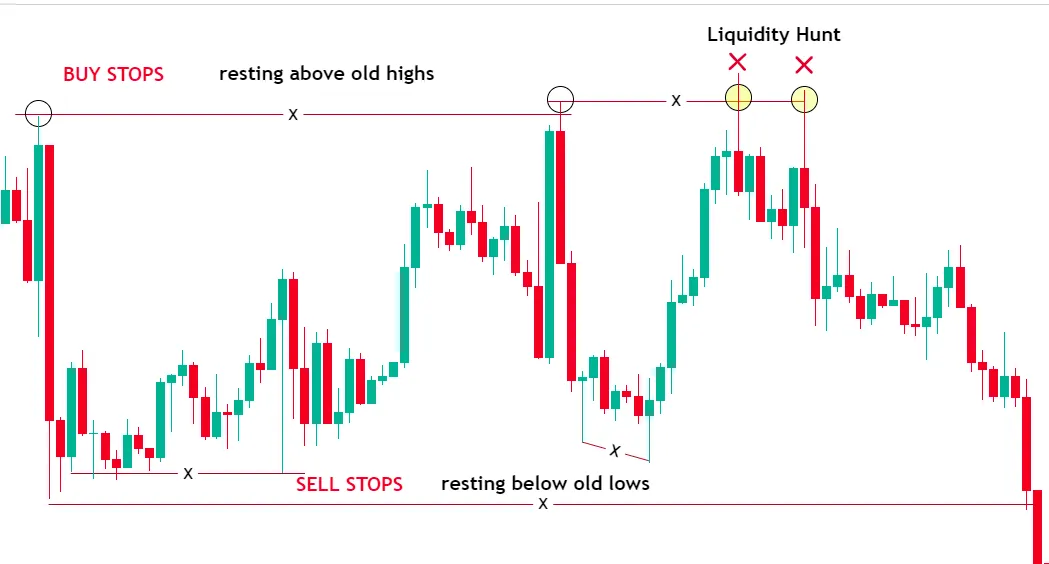
In a bullish day context: the Judas Swing is a downward move that sweeps sell-side liquidity (takes out a swing low, equal lows, or the Asian session low) before reversing sharply higher. The Judas Swing goes lower than where it should go for a bullish day — it appears to be a breakdown — and then immediately reverses.
In a bearish day context: the Judas Swing is an upward move that sweeps buy-side liquidity (takes out a swing high, equal highs, or the Asian session high) before reversing sharply lower. It appears to be a breakout — and then immediately reverses.
Timing the Judas Swing
The Judas Swing most commonly occurs at the beginning of the London session (7:00-8:30 AM London time / 2:00-3:30 AM New York time) or at the beginning of the New York session (7:00-9:30 AM New York time). These are the Killzone windows when the algorithm is most active and when the largest institutional order execution creates the commonly discussed Judas Swings.
- Before the London open, mark the Asian session high and low — these are the Judas Swing targets.
- In a bullish daily bias: expect the London session to sweep the Asian low (Judas Swing lower) before delivering higher.
- In a bearish daily bias: expect the London session to sweep the Asian high (Judas Swing higher) before delivering lower.
- After the sweep, watch for the reversal confirmation: a bullish or bearish MSS on the 5-minute chart.
- The FVG created by the post-Judas-Swing displacement is your entry — the trade that goes in the opposite direction of the Judas Swing.
The Judas Swing as an Entry Filter
The Judas Swing functions as a waiting period as much as it is a signal. Many ICT traders lose money by entering before the Judas Swing occurs — they see the daily bias is bullish and enter long before the Judas Swing sweeps the lows. The correct discipline is to wait. Do not enter before the Judas Swing. Once the sweep has occurred and the reversal MSS has formed, the trade has dramatically higher probability because the manipulation phase is complete and the distribution phase has begun.
Every time you consider entering a trade without having first seen the Judas Swing, ask yourself: "Has the manipulation phase occurred? Has the algorithm already swept the liquidity it needed?" If the answer is no — if the trade is based on the first move of the session without a prior sweep in the other direction — you may be entering during the Judas Swing itself, not after it. Wait for the sweep. The entry opportunity will still be there after the Judas Swing confirms.
Worked hypothetical example: classify a Judas-swing hypothesis
Before London opens, a trader records the Asian range and defines a minimum break beyond one side followed by a close back into the range. Price later crosses above the Asian high, closes inside, and breaks a short-term low. The sequence qualifies only under the prewritten rule; calling it a Judas Swing does not prove the move was deliberately designed to trap traders.
Failure case and what to test
Price may break the range and continue, sweep both sides or give no confirming structure break. Results are sensitive to the Asian-session definition, minimum overshoot, and daylight-saving handling. Include days without a qualifying setup, not only the classic textbook examples.
Test checklist
- Fix the Asian range window in New York local time or another explicitly named timezone.
- Define overshoot, return-inside and confirmation conditions.
- Set invalidation, target, time stop and maximum risk before entry.
- Record continuations, two-sided breaks and no-signal days with costs.
RELATED READING
Continue with guides selected for overlapping concepts and practical context.