ICT IRL vs ERL: Organizing Internal and External Reference Levels
Understand how ICT traders distinguish internal range references from external swing extremes, and how to test a target-selection hypothesis without assuming price must travel from one to the other.
Framework note: ICT terms are interpretations of price action, not proof of institutional motives or a market algorithm’s intent. No setup is guaranteed. Test clearly defined rules, account for costs and slippage, and use risk limits before risking capital. Read our editorial policy.
Internal Range Liquidity (IRL) and External Range Liquidity (ERL) form the target hierarchy within any ICT dealing range. IRL targets are inside the range — the FVGs, OBs, and imbalances that price delivers to during retracements. ERL targets are outside the range — the swing highs and lows beyond the range boundaries that represent the algorithm's ultimate delivery destinations. Mastering the IRL/ERL framework gives you a complete map of every trade's target structure before you enter.
Defining the Dealing Range
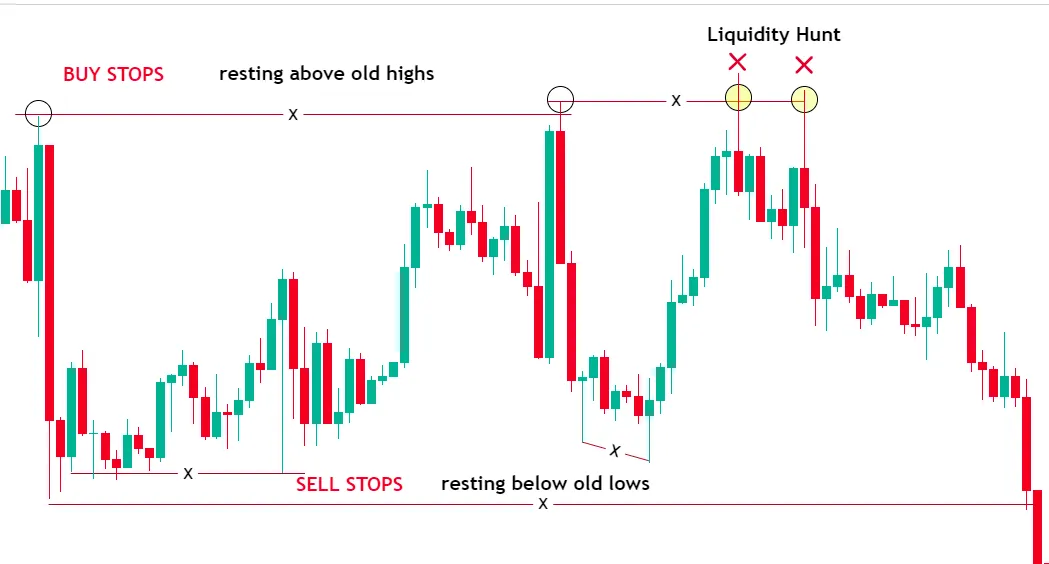
A dealing range is any defined price range bounded by a significant swing high (the top of the range) and a significant swing low (the bottom of the range). The boundaries of the range are the External Range Liquidity levels — the swing high holds Buy-Side Liquidity (BSL) above it, and the swing low holds Sell-Side Liquidity (SSL) below it.
Within the range, between the high and the low, sits the Internal Range Liquidity — all the PD Arrays (FVGs, OBs, BPRs, etc.) that were created as price moved from one extreme of the range to the other. These internal elements are the retracement targets and entry zones within the range.
How Price Moves Between IRL and ERL
Price delivery follows a predictable pattern within the IRL/ERL framework. The algorithm moves price from an ERL level (a swing extreme) through the range, hitting IRL targets (FVGs and OBs) along the way, until it reaches the opposite ERL level (the other swing extreme). Then it may reverse from the ERL and begin delivering back through the range in the opposite direction, again hitting IRL targets.
Understanding this cycle tells you where you are in the delivery sequence. If price has just swept an ERL (taken a swing high) and is now retracing, it is in an IRL delivery phase — targeting the FVGs and OBs inside the range. Once those internal elements are hit, price will resume toward the opposite ERL. Your trade targets change depending on which phase you are in: IRL targets during retracements, ERL targets during the primary delivery phase.
Practical IRL/ERL Application
- Mark your dealing range: identify the most recent significant swing high (BSL/ERL) and swing low (SSL/ERL) on your working timeframe.
- Mark all IRL elements within the range: FVGs (bullish and bearish), Order Blocks, Mitigation Blocks, BPRs, and opening gaps (NWOG/NDOG).
- Determine which phase you are in: has price recently swept the ERL and is now in a retracement (IRL delivery phase)? Or has price recently hit an IRL target and is now resuming toward the ERL (ERL delivery phase)?
- In an IRL delivery phase: target the FVGs and OBs inside the range. These are your take-profit levels.
- In an ERL delivery phase: target the swing high or swing low beyond the current range. These are your take-profit levels.
- For entries: enter at IRL elements (FVGs/OBs) when in an ERL delivery phase — you are buying the retracement within a continuation move.
IRL First, Then ERL — The Sequence
A crucial ICT rule: price almost always delivers to IRL targets first before reaching the ERL. When you identify a bullish daily bias targeting the previous week's high (ERL), price will not go directly there in a straight line. It will first hit internal FVGs and OBs (IRL) along the way. Understanding this means you do not set your stop just below your entry and target the ERL directly from the start — you manage the trade to give price room to hit the IRL targets while keeping the ERL as your full profit target.
The IRL/ERL framework is the solution to the most common ICT targeting problem: "I was right about the direction but took profit too early." By identifying all the IRL targets between your entry and the ERL, you can plan your partial profit-taking at each IRL while running a portion of the position to the full ERL target. This is how ICT traders capture the full range of a delivery rather than exiting at the first touch of any resistance.
Worked hypothetical example
A trader defines a dealing range between two confirmed swing extremes and marks an imbalance inside it as an internal reference. The outer high is tagged as an external reference. Price revisits the internal area and then turns before reaching the external high, which is recorded as one possible path rather than a broken rule.
Failure case and what to test
A trader can change the range anchors after the move and make targets appear obvious in hindsight. Internal and external labels organize a chart, but do not guarantee the order in which levels will be visited.
Test checklist
- Set range boundaries before assigning internal and external labels.
- Record which reference is touched first, including paths that invalidate the thesis.
- Keep target selection separate from entry confirmation and risk sizing.
RELATED READING
Continue with guides selected for overlapping concepts and practical context.