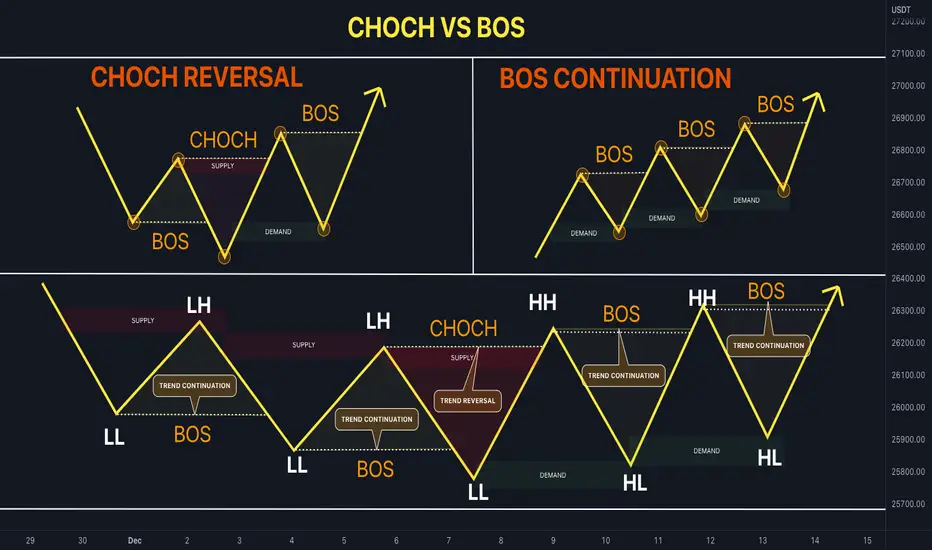
ICT Inducement After BOS: Separating Structure from Interpretation
Review how traders apply an inducement label after a Break of Structure, while avoiding claims that a market algorithm deliberately sets traps or that one sequence guarantees a trade.
Framework note: ICT terms are interpretations of price action, not proof of institutional motives or a market algorithm’s intent. No setup is guaranteed. Test clearly defined rules, account for costs and slippage, and use risk limits before risking capital. Read our editorial policy.
Inducement is the ICT concept that explains why so many technically correct setups fail. After a Break of Structure (BOS), retail traders identify what appears to be a valid entry zone — an Order Block, a Fair Value Gap, a retracement level. They enter with confidence. Then price runs their stop before finally delivering in the direction they expected. What they traded was inducement — a deliberate algorithmic trap designed to attract entries at the wrong level before the real move begins.
What Is Inducement?
In ICT methodology, inducement refers to the algorithm's deliberate creation of a setup that appears tradeable but is actually designed to trap traders. After a Break of Structure, the algorithm creates a retracement that looks like a textbook entry zone — it may even create a small Order Block or FVG at the retracement level. Retail traders see this apparent entry zone and position themselves, expecting the continuation move.
But the ICT interpretation offers another possible explanation. The apparent entry zone is inducement — it is designed to collect the retail entries (and their stop losses) as liquidity before the algorithm actually delivers to its intended target. Price sweeps through the inducement entry zone, triggering all those stops, and only then delivers in the expected direction from a deeper, more valid PD Array.
How Inducement Appears After a BOS
After a bullish BOS — price makes a higher high — a retracement begins. The retracement creates what appears to be a Higher Low forming at a visible Order Block or FVG. Retail traders buy that Higher Low setup expecting continuation. But the inducement plays out: price sweeps through that HL, taking out all the stops below it, before reversing from a deeper PD Array and delivering the true continuation move.
The inducement Higher Low was not the real entry — it was the trap before the real entry. The real entry zone was the deeper PD Array below the inducement level: the 4-hour Order Block, the daily FVG, the OTE zone. The inducement collected the premature buyers before the higher-probability entry zone was reached.
Identifying Inducement — The Key Signals
- The retracement level is too shallow — it has not reached any significant higher timeframe PD Array. If the HTF context suggests price should retrace to the 62-79% OTE zone and price only retraced 20-30%, the shallow retracement is inducement.
- The entry zone is not a clean PD Array — a small 5-minute FVG or minor OB after a BOS is more likely inducement than a genuine entry zone.
- There are stop orders visible below the apparent entry zone — if a clear equal low or STL sits below the entry zone, the algorithm still needs to collect that liquidity. The entry zone above those stops is inducement.
- The entry zone does not align with the HTF structure — a 5-minute OB at the 30% retracement level when the daily chart's PD Arrays are 60% lower is almost certainly inducement.
- Equal highs or equal lows exist in the path of the inducement sweep — these are the real targets, and the inducement entry zone sits above/below them.
Avoiding the Inducement Trap
The primary defense against inducement is patience and HTF alignment. Before entering any retracement trade after a BOS, ask: has price reached my HTF PD Array? If the answer is no — if the 4-hour OB or the OTE zone or the daily FVG has not yet been touched — wait. The retracement has not finished. What you are seeing is inducement.
The second defense: check for liquidity below your entry zone. If equal lows or any STL exists between your intended entry and the HTF PD Array, price will likely take that liquidity first. Wait for the liquidity below your entry to be swept before entering the trade.
A useful mental framework: every entry should have a reason to exist that goes beyond "the retracement looks like it is ending here." You need a confirmed HTF PD Array, alignment with the overall bias, no remaining liquidity between your entry and the next target, and a killzone or Macro window timing. If your entry cannot satisfy all four criteria, it may be inducement. Walk away and wait.
Worked hypothetical example
A trader marks a confirmed swing break and identifies a smaller nearby pivot as a possible inducement reference under the chosen rule. Price trades through the small pivot and continues in the breakout direction rather than reversing. The observation counts as a continuation case; the label is not changed to fit the result.
Failure case and what to test
The phrase inducement can imply intent that candle data alone cannot verify. With no objective swing or sweep conditions, nearly any pre-break move can be interpreted as a trap after the outcome is known.
Test checklist
- Specify the swing break and candidate inducement level before the move.
- Record reversals and continuations using the same definitions.
- Describe chart behavior without claiming to know participants' intent.
RELATED READING
Continue with guides selected for overlapping concepts and practical context.