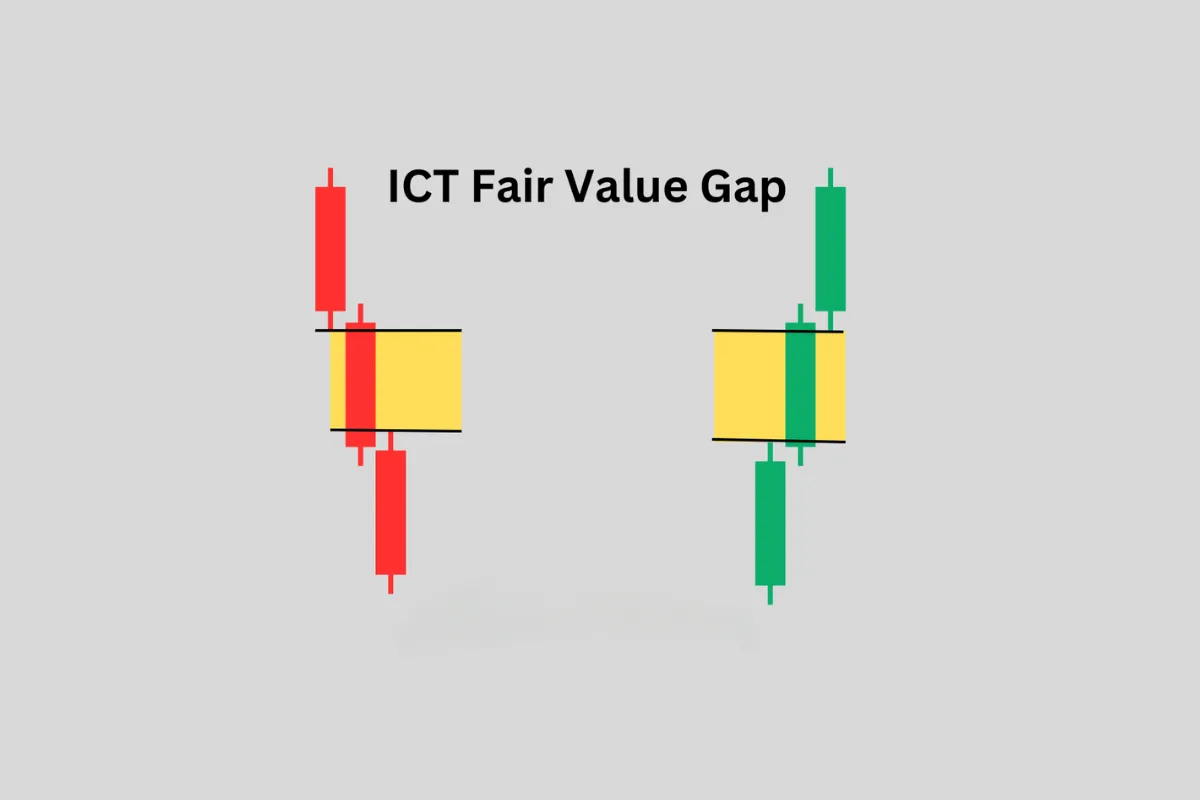
ICT Implied Fair Value Gap (IFVG) — The Inverted FVG Explained
An IFVG is commonly described as an imbalance that price has traded through and may later treat differently; the label alone does not predict a reversal or continuation.
Framework note: ICT terms are interpretations of price action, not proof of institutional motives or a market algorithm’s intent. No setup is guaranteed. Test clearly defined rules, account for costs and slippage, and use risk limits before risking capital. Read our editorial policy.
The Implied Fair Value Gap (IFVG) — also called the Inversion FVG or Inverted FVG — is one of the most important nuances in the entire Fair Value Gap framework. It answers the question every ICT trader eventually asks: "I bought this bullish FVG, but price ran right through it. Why? And what does that zone mean now?" The answer is the IFVG — the zone has not lost its significance, it has flipped its polarity.
How an IFVG Forms
A standard bullish Fair Value Gap acts as support — price enters from above, finds institutional buying interest, and reverses back up. An IFVG forms when price does not reverse from the bullish FVG but instead continues downward, trading completely through the gap from top to bottom. The FVG has been violated.
When a bullish FVG is fully violated — when price closes below the entire gap — the zone flips from bullish support to bearish resistance. The logic: the institutional buy orders that were waiting in that FVG have now been filled and exhausted. The buyers who entered in that zone are now trapped in a losing long position. When price returns to the IFVG zone from below, those trapped longs will exit, creating selling pressure. Additionally, new institutional short orders may be placed at that zone, treating it as a confirmed area of distribution.
Identifying the IFVG on Your Chart
- Mark all active bullish FVGs on your chart.
- Monitor each FVG as price approaches from above. If price enters the FVG but does NOT close below the bottom edge, the FVG is still active — it has not been violated.
- If price closes a candle below the bottom edge of the bullish FVG (fully through the gap), the FVG has been violated and becomes an IFVG — now acting as bearish resistance.
- For bearish FVGs: if price closes above the top edge of a bearish FVG, it flips to a bullish IFVG — acting as support on the next approach from below.
- Mark the IFVG clearly on your chart with a different color than your standard FVGs to avoid confusing active FVGs with inverted ones.
Trading the IFVG
Once an IFVG is established, it becomes a PD Array element in the new direction. For a bearish IFVG (former bullish FVG that was violated), wait for price to retrace back up into the IFVG zone. Enter short at the CE of the IFVG zone (the 50% midpoint of the original FVG). Stop: above the top edge of the original FVG. Target: the next sell-side liquidity pool below.
For a bullish IFVG (former bearish FVG that was violated), wait for price to return down into the IFVG zone. Enter long at the CE. Stop: below the bottom of the original FVG. Target: the next buy-side liquidity pool above.
IFVG vs Standard FVG — Probability Comparison
IFVGs tend to produce sharper reactions than standard FVGs in the new direction. The reason: standard FVGs have one layer of institutional significance (the unfilled imbalance). IFVGs have two layers — the original imbalance significance plus the confirmation of directional failure. When price returns to an IFVG, it is entering a zone that the market has already tested and rejected (from the standard FVG attempt), making the reaction zone more well-defined and more significant.
A critical rule for FVG trading: always mark which FVGs have been violated. Your chart should clearly distinguish between active FVGs (still acting in original direction), partially mitigated FVGs (entered but not fully violated), and IFVGs (fully violated and flipped). Treating a violated FVG as still bullish is one of the most expensive mistakes in ICT trading.
Worked hypothetical example
A trader marks a bullish FVG from 100 to 102 using a fixed three-candle rule. A later candle closes below the lower boundary, so the trader marks a candidate inversion for review. When price revisits 101, it continues upward through the zone rather than rejecting it; this outcome is kept in the sample.
Failure case and what to test
A wick through the gap and a closing break may be treated differently by different definitions. Chosen timeframe, candle construction and the required confirmation can change the number of candidates and results.
Test checklist
- Write the violation rule: wick, close or another preselected condition.
- Record which boundary is required for confirmation and invalidation.
- Compare IFVG candidates with ordinary FVG revisits and no-trade baselines.
RELATED READING
Continue with guides selected for overlapping concepts and practical context.