ICT Consequent Encroachment (CE): How to Mark the 50% Level
Learn how to calculate the 50% midpoint of a selected range, where ICT traders apply it and why the midpoint alone does not guarantee a fill or reaction.
Framework note: ICT terms are interpretations of price action, not proof of institutional motives or a market algorithm’s intent. No setup is guaranteed. Test clearly defined rules, account for costs and slippage, and use risk limits before risking capital. Read our editorial policy.
The Consequent Encroachment (CE) is one of the most frequently referenced terms in ICT trading, yet it is one of the simplest concepts: it is the 50% midpoint of any defined price range. Whether applied to a Fair Value Gap, an Order Block, a premium/discount range, or a weekly range, the CE always refers to the exact center of the zone. Its importance comes from the fact that it is the single most specific, objectively defined entry point within any PD Array.
CE of a Fair Value Gap
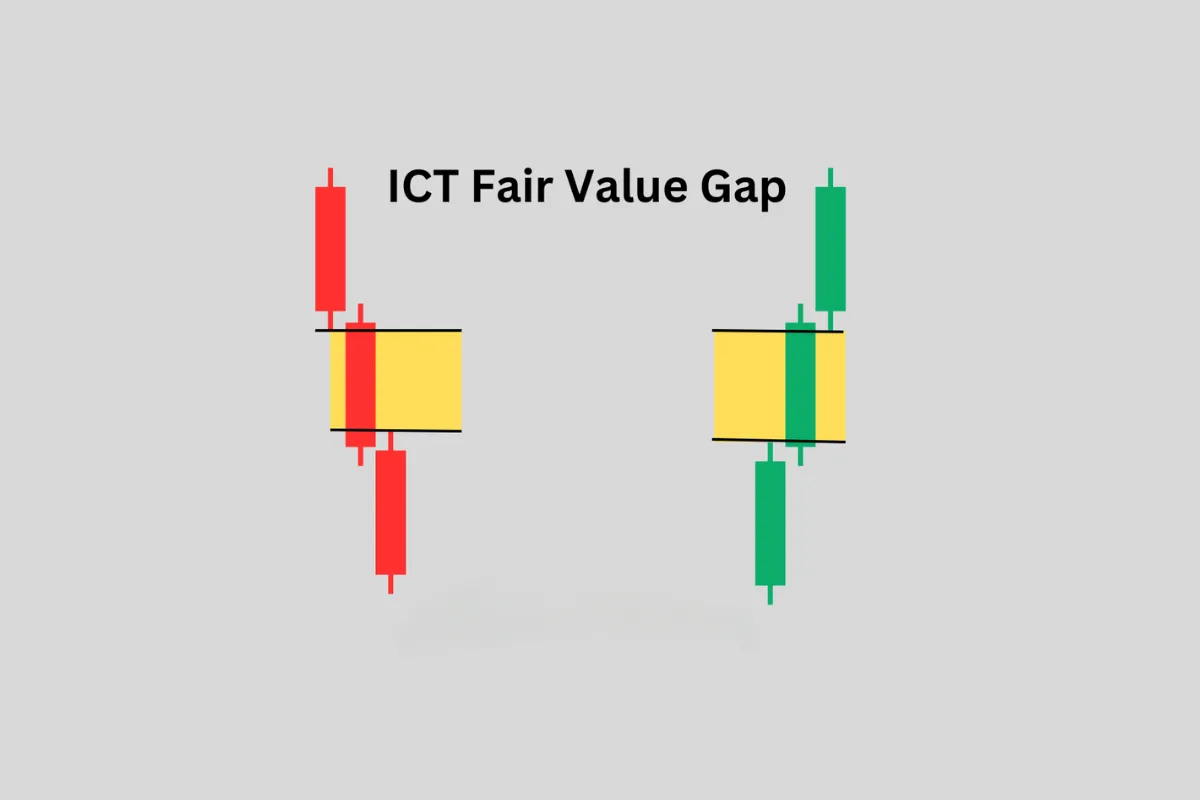
The most common application of the CE is within a Fair Value Gap. When you identify a three-candle FVG — defined by the high of candle 1 and the low of candle 3 (for a bearish FVG) or the low of candle 1 and the high of candle 3 (for a bullish FVG) — the CE is the exact midpoint between those two boundary levels. If a bullish FVG spans from 1.0850 to 1.0870, the CE is 1.0860.
Some traders place an order at the CE when their tested rules call for it. A touch does not guarantee an order fill at the expected price, and it does not guarantee a favorable reaction; account for slippage, spread and invalidation.
CE of an Order Block
The CE of an Order Block is the midpoint of the OB candle's body — the 50% level between the open and close of the OB candle (not the high and low, but the body). This distinction is important: using the body midpoint rather than the full candle range gives a tighter, more precise entry level that is closer to the actual institutional order zone.
CE as the Premium/Discount Equilibrium
At the dealing range level, the CE is the 50% equilibrium between the range high and range low. This is the premium/discount dividing line: above the CE is premium; below is discount. Every time you apply the premium/discount framework, you are using the CE of the dealing range as your reference point.
- For FVG entries: set limit order at the CE of the FVG (midpoint of the gap boundaries).
- For OB entries: set limit order at the CE of the OB body (midpoint between open and close of the OB candle).
- For premium/discount analysis: mark the CE of the current dealing range as the equilibrium line.
- For Fibonacci OTE: the 50% Fibonacci level is the CE of the swing — the equilibrium price.
- For BPR entries: the CE of the overlap zone (the Balanced Price Range midpoint) is your entry level.
The CE provides a precise 50% reference inside a defined range, which can make a rule easier to state and test. It is not a required entry for every setup, and it does not remove judgment from selecting the range, confirming a setup or managing risk.
Worked hypothetical example
Imagine a hypothetical Fair Value Gap between 100 and 110 price units. Its midpoint is 105. A trader may test a rule that waits for price to trade to 105, then requires a separate confirmation condition before entry. If price never returns to 105, the trade is recorded as not triggered rather than counted as a loss or a missed guaranteed move.
Failure case and what to test
A midpoint is a calculation, not evidence that the market will respect it. The range used to draw the gap is itself selected by a rule, and a midpoint touch can occur during a strong move through the zone. Test limit-entry and confirmation-entry approaches separately.
Test checklist
- Define the two boundaries and calculate the midpoint mechanically.
- Track touch, fill, slippage and subsequent adverse movement separately.
- Compare outcomes with an edge-of-zone entry and a no-trade baseline.
RELATED READING
Continue with guides selected for overlapping concepts and practical context.