ICT 2022 Model: Setup Rules, Context and Limitations
A structured overview of the 2022-model framework as presented in ICT education, including time, price, structural confirmation and risk planning, without implying a universal strategy or standard risk schedule.
Framework note: ICT terms are interpretations of price action, not proof of institutional motives or a market algorithm’s intent. No setup is guaranteed. Test clearly defined rules, account for costs and slippage, and use risk limits before risking capital. Read our editorial policy.
The 2022 Trading Model is a framework presented in ICT educational material, commonly combining time-window context, price references and structural entry conditions. Calling it complete or superior does not establish predictive value; outcomes depend on specific rules and testing.
The Foundation: Time and Price
The model is often explained through time filters and price zones. Those are organizing components of the framework, not proof that a setup occurring in both contexts has positive expectancy; define each filter and test its incremental contribution.
The 2022 Model Framework — Step by Step
- Step 1 — Quarterly Shift: Identify the current quarterly directional bias (January-March, April-June, July-September, October-December). Each quarter has an institutional directional delivery that overrides short-term fluctuations.
- Step 2 — Monthly Bias: Within the quarterly shift, determine the current month's expected direction. Is price expanding to the upside or contracting to the downside within this quarter?
- Step 3 — Weekly Bias and DOL: Identify the weekly draw on liquidity — the previous week's high or low, or a higher timeframe PD Array that price is targeting this week.
- Step 4 — Daily PD Array: Mark the specific daily PD Array (FVG, OB, or BPR) that price is most likely to deliver to during the current or next trading session.
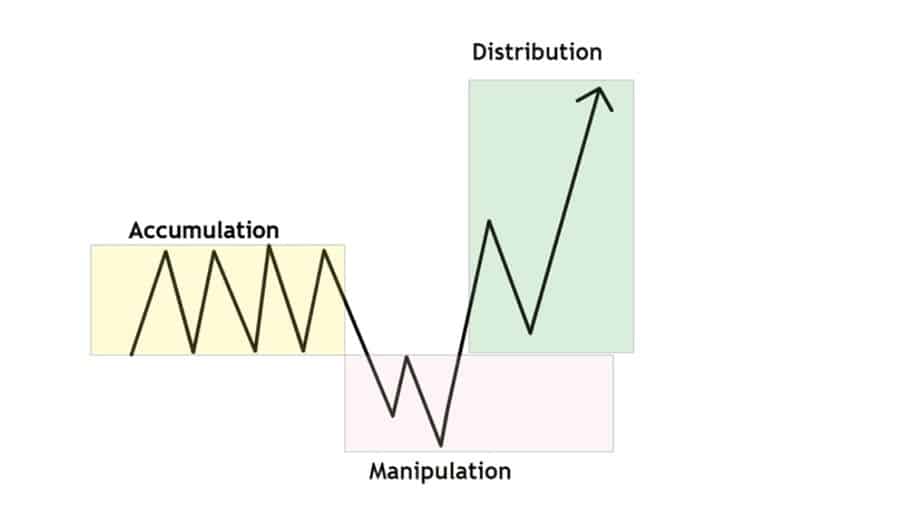
- Step 5 — Killzone Execution: Wait for the London or New York Killzone. Within the Killzone, wait for the AMD pattern — the manipulation phase (Judas Swing/liquidity sweep) followed by the distribution phase (true directional move).
- Step 6 — Entry Model (IOFED): After the manipulation sweep, identify the displacement FVG. Enter at the CE. Stop beyond the FVG. Target: the daily DOL.
The Judas Swing in the 2022 Model
Some ICT explanations use Judas Swing for a move that goes beyond a reference before later price action turns. That sequence can be described on the chart, but it does not prove deliberate manipulation or establish the direction of the next move.
Under one entry model, a trader waits for a defined swing break after a move through a reference level. This is a chosen confirmation rule; it does not establish that the previous move was a deliberate trap or guarantee follow-through.
The 2022 Model Risk Framework
Risk values such as per-trade, daily and weekly limits are choices for an individual plan, not universal settings established by the model label. Set values that fit your own limits and applicable account terms, and test that the plan is workable after costs.
Profit targets: the 2022 model uses the next liquidity pool as the primary target, with partial exits at the first FVG in the path and full exit at the ERL target. ICT teaches using at least a 3:1 minimum R:R for any 2022 model trade — if the distance to the DOL target is less than three times the stop size, the setup does not qualify.
The Mental Framework of the 2022 Model
Beyond the technical framework, the 2022 model includes a specific mental approach. ICT emphasizes: "Be a sniper, not a machine gunner." One high-quality trade per session, maximum. Patient waiting for the Judas Swing rather than trying to catch every move. Accepting that missing a setup is preferable to forcing a low-probability entry. The discipline to follow the model without deviation, even when the market appears to be offering something else.
The 2022 model can be summarized in one sentence: wait for a liquidity sweep during a Killzone within the direction of your HTF bias, confirm the MSS after the sweep, enter the FVG created by the post-sweep displacement, and target the next liquidity pool. Everything else in ICT — every PD Array, every structural concept, every timing tool — serves to refine and confirm this core sequence. Master the 2022 model and you have mastered the practical application of ICT.
Worked hypothetical example: specify a 2022-model checklist
For practice, a trader predefines a higher-timeframe directional condition, a marked reference level, a session window, and a lower-timeframe entry trigger. On a hypothetical day, the first three conditions occur but the entry trigger does not; the session is logged as no trade. The trader does not manufacture an entry because the model is expected to work or because a target appears likely in hindsight.
Failure case and what to test
The setup can fail at the bias step, miss its time window, trigger and stop out, or never form. Model definitions differ between traders, so performance claims are meaningful only when exact rules, market, period, costs and sample count are supplied. Do not treat course examples as verified live or backtest results.
Test checklist
- Write each model condition in observable terms, including no-trade rules.
- Record every eligible session from the start of the sample.
- Track stop-outs, skipped trades, drawdown and transaction costs.
- Keep a holdout period and avoid tuning multiple rules to the same data.
RELATED READING
Continue with guides selected for overlapping concepts and practical context.