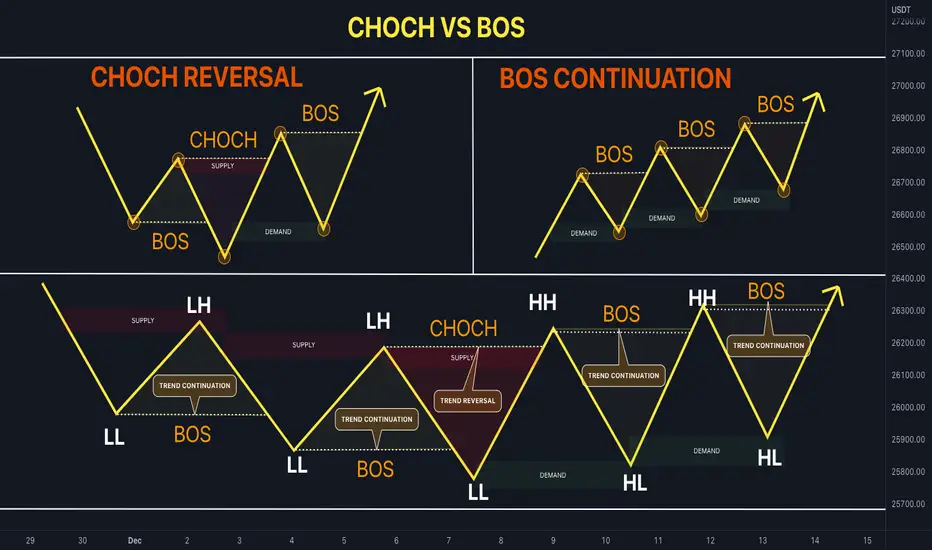
ICT BOS vs ChoCH — Break of Structure vs Change of Character
Compare Break of Structure and Change of Character as terminology used to describe different structural events, while documenting the swing rules that make those labels reproducible.
Framework note: ICT terms are interpretations of price action, not proof of institutional motives or a market algorithm’s intent. No setup is guaranteed. Test clearly defined rules, account for costs and slippage, and use risk limits before risking capital. Read our editorial policy.
Break of Structure (BOS) and Change of Character (ChoCH) are the two foundational structural events that define trend continuation and potential trend reversal in ICT methodology. Every structural change on every timeframe is classified as either a BOS (confirming the trend) or a ChoCH (warning of reversal). Mastering this classification system gives you a clear, objective framework for reading price direction without any indicators.
Break of Structure (BOS) — Trend Continuation
A Break of Structure occurs when price breaks in the direction of the existing trend, confirming that the trend is continuing. In a bullish trend (Higher Highs, Higher Lows), a BOS is when price breaks above the most recent Higher High — creating a new Higher High and confirming the uptrend is intact. In a bearish trend (Lower Highs, Lower Lows), a BOS is when price breaks below the most recent Lower Low, confirming the downtrend continues.
The BOS is your green light for trend-following trades. When a BOS occurs after a retracement into a PD Array, it confirms that the retracement was just a pullback within the trend and the primary direction is resuming. Your entries at PD Arrays during retracements are validated when a BOS follows your entry — the trend-following trade is working.
Change of Character (ChoCH) — Potential Reversal
A Change of Character is when price breaks against the direction of the existing trend for the first time — the first structural deviation that suggests the trend may be losing momentum. In a bullish trend, a ChoCH occurs when price breaks below the most recent Higher Low. In a bearish trend, a ChoCH occurs when price breaks above the most recent Lower High.
The ChoCH is a warning, not a confirmed reversal. It says: "the trend has deviated from its pattern for the first time." It does not say "the trend has reversed." Multiple ChoCHs must sometimes occur before a genuine trend reversal is confirmed. A single ChoCH can still lead to a return to the original trend direction after a deeper retracement.
The Structural Sequence — How BOS and ChoCH Work Together
- In a bullish trend: BOS (new HH) → pullback to HL → BOS (another new HH) → pullback to HL → eventually ChoCH (HL broken) → MSS (LH broken) → potential trend reversal.
- The transition from trend to reversal requires: ChoCH first (breaks the HL), then MSS (breaks the subsequent LH), then a new sequence of LH and LL confirming bearish delivery.
- For trade entries: buy when price pulls back to a PD Array after a BOS. Sell when price pulls back to a PD Array after a bearish ChoCH and MSS sequence.
- Never buy on a ChoCH in a bullish trend without confirmation. The ChoCH may be a retracement, not a reversal — buying into a deeper pullback leads to being stopped out.
- Trade the BOS direction: if the last structural event was a BOS (continuation), trade in the BOS direction. If the last structural event was a ChoCH followed by an MSS (reversal), trade in the new direction.
Timeframe Hierarchy of BOS and ChoCH
On the daily chart, a ChoCH is a significant structural event that requires reconsidering the weekly bias. On the 5-minute chart, a ChoCH may simply be the algorithm setting up for a Silver Bullet entry. The significance of each BOS and ChoCH is entirely relative to the timeframe on which it occurs. A 1-minute ChoCH means almost nothing for a daily swing trade. A daily ChoCH means everything.
Build a structural log: every day, note the most recent significant BOS and ChoCH on the daily chart. Update it each morning before trading. This practice forces you to stay current with the macro structure and prevents the common mistake of trading counter-trend entries when the daily structure is firmly trending in one direction.
Worked hypothetical example
In a hypothetical uptrend, a trader marks a higher low and the prior swing high. A close above the prior high is labeled BOS under the chosen rule; later, a break below the marked higher low is logged as a possible countertrend structural change. The labels describe the sequence but do not confirm how far price will travel.
Failure case and what to test
Educators may use BOS and ChoCH differently, and changing the swing-definition rule after a move can relabel the same chart. A structural break may fail, reverse again or be too small to trade after costs.
Test checklist
- Document how a swing becomes confirmed and whether closes or wicks count.
- Apply the same definitions to continuation and reversal cases.
- Separate the structural label from the trade entry and risk decision.
RELATED READING
Continue with guides selected for overlapping concepts and practical context.