ICT Fair Value Gaps (FVG): Formation, Retests and Risk Rules
Learn how traders define three-candle fair value gaps, set retest and invalidation rules, and review all outcomes with execution costs. A gap does not reveal who traded there or predict that price will return.
Framework note: ICT terms are interpretations of price action, not proof of institutional motives or a market algorithm’s intent. No setup is guaranteed. Test clearly defined rules, account for costs and slippage, and use risk limits before risking capital. Read our editorial policy.
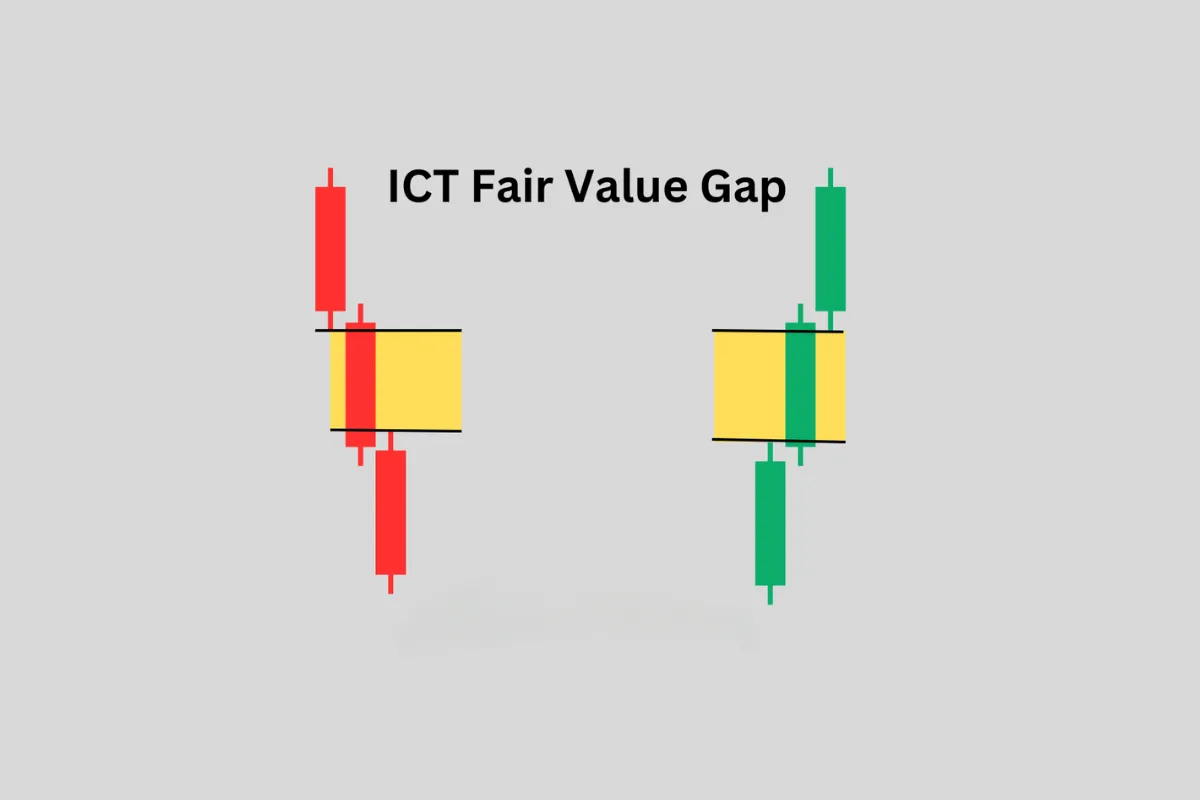
Under a common three-candle definition, a bullish FVG occurs when the first candle's high is below the third candle's low; a bearish FVG is the inverse. This describes non-overlapping candle extremes, not proof that buyers or sellers could not trade at intervening prices.
The Institutional Logic Behind Fair Value Gaps
FVGs describe the relationship between selected candle extremes. A sharp move may leave a gap under this definition, but a chart does not establish that an algorithm created it to reach a higher-timeframe liquidity target.
A three-candle FVG marks a gap between selected candle extremes. The pattern alone does not prove that orders were skipped or remain unfilled, and price may revisit the zone or leave it open.
How to Identify a Fair Value Gap
A bullish Fair Value Gap (BISI — Buy Side Imbalance, Sell Side Inefficiency) forms when the high of candle one does not overlap with the low of candle three. The gap between candle one's high and candle three's low is the FVG. It represents a zone where buyers were so aggressive that sellers could not participate at those price levels.
A bearish Fair Value Gap (SIBI — Sell Side Imbalance, Buy Side Inefficiency) forms when the low of candle one does not overlap with the high of candle three. Sellers moved price down so aggressively that buyers could not participate. The gap represents unfilled sell orders waiting above current price.
- Step 1: Identify a displacement move — a series of large-bodied candles moving strongly in one direction with FVGs embedded within them
- Step 2: Mark the high of candle one (for bullish FVG) or the low of candle one (for bearish FVG)
- Step 3: Mark the low of candle three (for bullish FVG) or the high of candle three (for bearish FVG)
- Step 4: The zone between these two levels is your Fair Value Gap
- Step 5: Identify the Consequent Encroachment (CE) — the exact 50% midpoint of the gap, which is the confluence-based entry point
- Step 6: Confirm the FVG aligns with your HTF bias before considering it as an entry zone
Types of Fair Value Gaps
ICT teaching distinguishes several FVG types, but their usefulness depends on the rule being tested. Some traders study the first presented FVG in a displacement sequence; test it against other FVGs and include failures, non-revisits and transaction costs in the sample.
In one ICT convention, an FVG may be relabelled an inversion FVG after price trades through a defined boundary. Specify whether a wick or close counts as a violation; the reclassification does not guarantee that the area will act as support or resistance on a future return.
A Balanced Price Range (BPR) is an FVG-related concept in ICT education, usually identified where bullish and bearish FVG zones overlap. The overlap is visible; claims about institutional orders being stacked there are interpretations. Whether price reacts at a BPR, passes through it or never revisits it should be measured in a defined backtest.
Consequent Encroachment — The Most Important Level Inside Every FVG
The Consequent Encroachment (CE) is the 50% midpoint of any Fair Value Gap. This is not an arbitrary level — it represents equilibrium within the inefficiency, the point where the gap is half-filled. ICT teaches that the CE is the primary entry target when price returns to an FVG, because it offers the best balance between entry precision and gap fill probability.
Many retail traders set entries at the edge of the FVG and wonder why they get stopped out before price respects the zone. The reason is that price frequently pierces the top of a bullish FVG slightly before reversing from near the CE. Trading to the CE specifically, rather than the edge, may help structure entry precision.
The Common Mistakes Traders Make with FVGs
- Trading every FVG regardless of higher timeframe context — FVGs only have high probability when they align with the broader institutional order flow direction
- Ignoring the displacement that created the FVG — without a genuine displacement move, the gap may not have institutional significance
- Treating all FVGs equally — if a strategy prioritizes the first FVG in a sequence, test it against later gaps and record failed examples
- Failing to account for the IFVG — a FVG that has been violated becomes resistance, not support, yet traders continue to buy it
- Setting stop losses inside the FVG — the stop should be below the entire FVG, not inside it
- Not confirming on multiple timeframes — a 5-minute FVG inside a bearish 4-hour structure is low-probability regardless of how clean it looks
FVG Entry Logic: Step by Step
A proper FVG entry begins with top-down analysis. On the daily or 4-hour chart, confirm the direction of the institutional order flow. Identify the draw on liquidity — where is price likely going? Confirm that the FVG you are targeting is in the correct direction of the higher timeframe bias.
When price returns to the FVG, watch for delivery to the CE area. Look for a lower timeframe (1-minute or 5-minute) displacement away from the FVG as confirmation that institutional orders are being triggered. Enter on a limit order at the CE or on the LTF displacement confirmation. Place your stop loss below the entire FVG (for long trades) or above it (for short trades). Your target is the next pool of liquidity in the direction of your bias.
Key rule: An FVG without a displacement move that created it is just a gap — the visual pattern alone does not prove institutional activity. Define a consistent displacement rule and test it against examples that succeed and fail.
Worked hypothetical example: classify an FVG revisit
Assume candle one's high is 100.00 and candle three's low is 100.40, creating a 0.40-point bullish FVG under the chosen three-candle definition. A later candle revisits 100.20 and then trades to 99.95. Under a rule that defines full invalidation as trading below the lower boundary, this is not a clean rejection. Record the partial revisit and boundary break rather than relabeling the zone after observing the outcome.
Failure case and what to test
An FVG may be partly filled, crossed completely, revisited only after the intended session, or never revisited within the observation window. Test different minimum-gap filters and clearly specified entry/stop rules without changing definitions from chart to chart. A gap is a visible candle relationship, not proof of unfilled institutional orders.
Test checklist
- Fix the candle and equal-price rules used to define a gap.
- Set the revisit horizon, entry trigger, stop and target before testing.
- Log no-revisit, partial-fill, full-fill and continuation cases.
- Include costs and compare results with a simple baseline on unseen data.
RELATED READING
Continue with guides selected for overlapping concepts and practical context.