ICT Draw on Liquidity: Candidate Targets and Invalidations
Learn how traders select possible target levels from prior highs, lows and range boundaries, define invalidation and log whether targets are reached without treating them as known destinations.
Framework note: ICT terms are interpretations of price action, not proof of institutional motives or a market algorithm’s intent. No setup is guaranteed. Test clearly defined rules, account for costs and slippage, and use risk limits before risking capital. Read our editorial policy.
Draw on Liquidity (DOL) is an ICT term for a possible target selected from references such as prior highs, lows or equal highs and lows. It is a pre-trade hypothesis, not a precise forecast of where an algorithm will deliver price.
Why Price Has a Target Before It Starts Moving
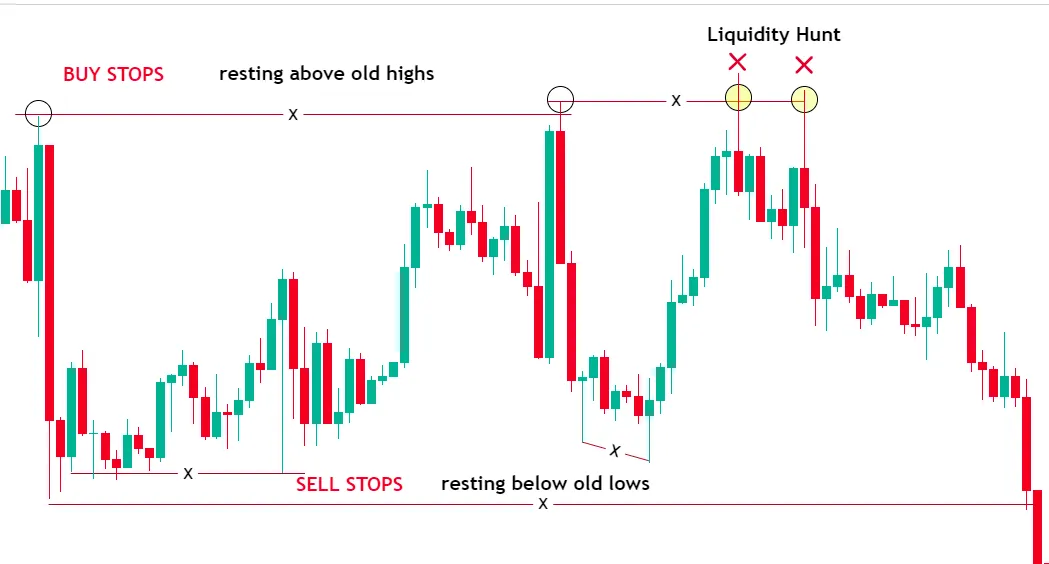
The ICT framework interprets price movement through selected reference levels, but it does not establish a single cause for every move. Every move from Point A to Point B is a delivery from one liquidity pool to another. The algorithm collects liquidity at Point A (through a stop hunt, through a squeeze, through a manipulation) and then delivers price to Point B (the next liquidity pool that needs to be reached). Understanding this means every significant move has a predetermined target.
In this framework, a Draw on Liquidity (DOL) is commonly identified as a possible liquidity target — either Buy-Side Liquidity (above swing highs, equal highs, previous high levels) or Sell-Side Liquidity (below swing lows, equal lows, previous low levels). Price can move between many kinds of levels for many reasons; the next liquidity pool is a hypothesis, not a predetermined destination.
Internal vs External Draw on Liquidity
Internal Range Liquidity (IRL) refers to the targets within the current dealing range — FVGs, OBs, gaps, and imbalances inside the range. External Range Liquidity (ERL) refers to the targets outside the current range — the swing highs and lows beyond the range that represent the ultimate destination.
IRL and ERL group possible internal and external reference levels. Price may move between them, skip one or break through the range; a sequential cycle should be treated as a testable scenario rather than a fixed rule.
- After an ERL sweep (swing high taken), look for price to retrace into an IRL level (FVG or OB) before the next ERL target is reached
- Some ICT traders define rules for entries at IRL levels with a possible ERL target; test continuation and failure cases rather than assuming the target will be reached
- Equal Highs and Equal Lows are the most obvious ERL targets — every retail trader can see them, meaning maximum liquidity accumulation exists at those levels
- Previous Day High/Low, Previous Week High/Low, and Previous Month High/Low are all ERL targets that the algorithm frequently delivers to
- NWOG (New Week Opening Gap) and NDOG (New Day Opening Gap) are IRL targets that get filled before the ERL delivery continues
Identifying Your DOL Before the Session
Before each trading session, mark the following liquidity pools on your chart: the most recent swing high and swing low on the daily chart; equal highs or equal lows if they exist; the previous day high and low; the previous week high and low; any open FVGs on the 4-hour or daily chart. Then ask: given my daily bias and the current market structure, which of these levels is price most likely being drawn toward today?
Your DOL becomes your take-profit target before you ever enter a trade. Every trade has both an entry and an exit defined before execution. The entry is in the IRL (FVG or OB at your killzone). The exit is at the DOL — the ERL target that the algorithm is delivering toward. This pre-planned structure is what separates systematic ICT trading from guesswork.
A single powerful exercise: every week, before the market opens on Monday, identify the weekly DOL — where do you believe price will deliver by Friday? Write it down. Then review your accuracy weekly. Traders who practice DOL identification consistently become dramatically better at reading the market's intentions within 60-90 days of dedicated practice.
Worked hypothetical example
A trader marks the prior-week high and low before the new week opens and chooses the high as a potential objective based on a stated range condition. Price first falls through an internal swing low and never reaches the prior-week high during the sample. The result is recorded as a path that did not reach the planned reference.
Failure case and what to test
A target can be selected after price is already moving toward it, making the idea look more precise than it was. Markets may reach another level first, reverse or remain in a range, and no single liquidity objective is guaranteed.
Test checklist
- Choose candidate levels and selection rules before the period begins.
- Record missed targets and alternative levels reached first.
- Compare the chosen reference with a baseline such as prior-day high/low.
RELATED READING
Continue with guides selected for overlapping concepts and practical context.